|
Poems, prayers, memoirs, and manifestos from the tribal archives
Compiled by Don Shewey 1994
APHRODITE'S BUTT AUDIENCE
AUDRE LORDE
BARBARA STANWYCK BODY WORSHIP
CHANGE CHAOS
COMMUNITY COMPASSION
COMPLEXITY CONFUSION
CRUELTY
DAILY PRACTICE
DARE TO KNOW DEATH
DEPRESSION
EROS AS RESISTANCE
THE EROS OF DYING
FAGGOT FEAR
FIRST TOUCH FORTY
GOD
HARRY KONDOLEON'S LAST POEM
HOW TO LOVE YOURSELF
IMAGINATION INSOMNIA
INTELLECTUAL
THE JOY OF FAILURE
KISS
LIFE CLASS LOST
LOVE
MASTERY MEDIA
MOTHER MUTUALITY
NOT KNOWING
OLD
THE PATH POETIC TERRORISM
POSSIBILITY PROMISCUITY
PROVERBS
Q&A
REVOLUTIONARY PATIENCE
RITUAL RUDE
THE RULES
SECRET OF LIFE
SEX SHAMANARCHY
SILENCE SPEED
STAGNANCY AND SLIPPAGE
TABOO TEARS
TELLING YOUR STORY
THERAPY THREESOME
TO BE OR NOT TO BE
UNCERTAINTY
VULNERABILITY
WE SUCK
X-RATED
YOUR JOB
ZEUS ENERGY
APHRODITE'S BUTT
Of all the goddesses Aphrodite is the only one not ashamed to be seen unclothed, not shy of making love out in the open under the midday sun...The myths associated with Aphrodite are about all the dangers of promiscuous and obsessive loving, of incestuous desire and unnatural passion...Above all Aphrodite reminds us of the inescapable transience of all mortal bonds, of how all love means loss, of how the most difficult challenge of love is really to know that, from having lived it, and yet to be ready to love again.
-- Christine Downing
*
Aphrodite was sometimes pictured as a Goddess appreciative of her backside, which was traditionally considered something to be appreciated. She was called Kalliglautos, She of the Lovely Behind. One of her characteristic postures was
anasyrma, the lifting of her dress to reveal her naked body
and looking behind, over her shoulder at her backside. Dances were performed to her in which women lifted their skirts.
-- Thomas Moore
AUDIENCE
It is not by any means necessarily an objection to a book when anybody finds it impossible to understand: perhaps that was part of the author's intention -- he did not want to be understood by just "anybody." Every more noble spirit and taste selects its audience when it wishes to communicate itself; and choosing them, it at the same time erects barriers against "the others." All the more subtle laws of any style have their origins at this point: they at the same time keep away, create distance, forbid "entrance,"
understanding ...while they open the ears of those whose ears are related to ours.
-- Friedrich Nietzsche
AUDRE LORDE
To acknowledge privilege is the first step in making it available for wider use. Each one of us is blessed in some particular way whether we recognize our particular blessings or not. And each one of us must clear a space within that blessing where she can call upon whatever resources are available to her in the name of something that must be done....
Are you willing to use the power that you have in the service of what you say you
believe?
BARBARA STANWYCK
My three goals are to eat, to survive, and to have a good
coat.
BODY WORSHIP
If I worship one thing more than another it shall be the spread
of my own body, or any part of it,
Translucent mould of me it shall be you!
Shaded ledges and rests it shall be you!
Firm masculine colter it shall be you!
Whatever goes to the tilth of me it shall be you!
You my rich blood! your milky stream pale strippings of my life!
Breast that presses against other breasts it shall be you!
My brain it shall be your occult convolutions!
Root of wash'd sweet-flag! timorous pond-snipe! nest of guarded
duplicate eggs! it shall be you!
Mix'd tussled hay of head, beard, brawn, it shall be you!
Trickling sap of maple, fibre of manly wheat, it shall be you!
Sun so generous it shall be you!
Vapors lighting and shading my face it shall be you!
You sweaty brooks and dews it shall be you!
Winds whose soft-tickling genitals rub against me it shall be you!
Broad muscular fields, branches of live oak, loving lounger
in my winding paths, it shaLl be you!
Hands I have taken, face I have kiss'd, mortal I have evertouch'd, it shall be you.
-- Walt Whitman
CHANGE
Whatever is denied, avoided, and not looked at holds the energy for meaningful change. Change comes from the unfinished areas, not from pretensions of wholeness.
-- Michael Meade
*
Meditation is most fundamentally a training for living well and dying well, a training for compassion and understanding that can allow you to be wise in the midst of all changing experiences.
-- Jack Kornfield
CHAOS
Agents of chaos cast burning glances at anything or anyone capable of bearing witness to their condition, their fever of
lux et voluptas. I am awake only in what I love & desire to the point of terror -- everything else is just shrouded furniture, quotidian anesthesia, shit-for-brains, sub-reptilian ennui of totalitarian regimes, banal censorship & useless pain.
Avatars of chaos act as spies, saboteurs, criminals of amour fou, neither selfless nor selfish, accessible as children, mannered as barbarians, chafed with obsessions, unemployed, sensually deranged, wolfangels, mirrors for contemplation, eyes like flowers, pirates of all signs & meanings.
Here we are crawling the cracks between walls of church state school & factory, all the paranoid monoliths. Cut off from the tribe by feral nostalgia we tunnel after lost words, imaginary bombs.
The last possible deed is that which defines perception itself, an invisible golden cord that connects us: illegal dancing in the courthouse corridors. If I were to kiss you here they'd call it an act of terrorism -- so let's take our pistols to bed & wake up the city at midnight like drunken bandits celebrating with a fusillade, the message of the taste of chaos.
-- Hakim Bey
COMMUNITY
I went with a group of men to the men's house....I was sitting on the floor, asking questions and writing answers in my journal, when I noticed that I was being surrounded by a group of men who were lifting me by the elbows, urging me to stand up. They took my arms and legs and held me horizontally at the waist level, grunting all the time, "Uh! Uh! Uh!" There were fourteen, all older men, thirty-five or more. Some were naked; others, like myself, wore shorts. They carried me slowly to one end of the long room, turned and carried me to the other end, then back to the central fireplace. The grunting sounds made me shiver. The hands and arms of the men carrying me were hot; perspiration from them slid down onto my own arms and chest. I could look into the circle of faces, all grinning but expressing no mood I could interpret. The man at my right shoulder leaned down and sucked my nose. The grunting continued. The man moved to suck my chin, my earlobes, my fingers one by one. he sucked my nipples, opened my pants and sucked my penis, then sucked on each of my ten toes. My body was not held rigidly, but seemed to be levitating slowly up and down. By the time the first man had passed my head and was at my nipples, the man next to him was leaning over to suck my nose. A third man started, then a fourth, until all fourteen had sucked on all extensions of my body. It was not an erotic experience. Although the men were sucking my penis, I had no erection; my penis and nipples are quiescent. I found myself involved in being the object of a ritual whose purpose was unknown to me. I knew, however, that my smell and body liquids were being absorbed and were becoming part of the men, as if they were imbibing the strength and magic they thought was in me, a magic that would give them not only strength but added prestige that would frighten off the evil spirits of the recently dead. I, in turn, was drawing into my own body their power, ruggedness, the richness of their knowledge and being.
As the men were putting me down and embracing me, I heard the grunting of other men outside, carrying Father Pietre. He was wearing his black robes, stained with perspiration at his armpits and chest. The men brought him up into the men's house, carried him around the room, then stopped in the center. I could not see what was happening, only the bobbing heads of the men bending to suck his nose and chin.
"Tidak! Tidak!" he yelled. "No! No!" The men finally put him down. He was somewhat ruffled, but the buttons at his neck were still intact, his skirts still unwrinkled.
"I've heard of this ceremony," he said to me, "but I have never seen it. It is a kind of friendship and adoption ritual, but I think it was done primarily to get you to buy the ancestor poles."
Years later I asked Akatpitsjin to explain it.
"Mbi urum, it is called," he said. "We have it when we are trying to make peace in the village, when we want nothing to disturb the life here. When we suck on your chin and nose and penis and fingers, we take in some of your spirit with the waters of your body. This makes us strong and calms the spirits of the dead.
"It is like when a man dies," he went on, "we suck on his penis, too, and we keep something of him inside ourselves, inside the village. We want to get rid of his spirit as quickly as possible before it can do us harm. The relatives put bands of rattan on their arms, on their shoulders, on their legs. The men and the women are together. Drums are beaten from morning until evening. The women are wearing hats so they cannot see what is happening and be shamed. The men open the women's skirts and suck their vaginas. The women suck the men's penes, too, absorbing the healthy essence that will drive away all evil. Those who are sucked are carried around the house to the sound of grunting, 'Uh! Uh! Uh!', a sound we call
omen. In the morning all the bad spirits are gone."
The mbi urum rites marked the beginning of my closest friendships with Asmat men. The fact that they knew me and my body so well gave me the feeling that I was not only close to them but that in the process of their wanting part of me inside them and part of them inside me, we were all being made into a single being, that all our individual characteristics were being combined into a universal concept of life itself. Although this feeling began with the ceremony, it was Akatpitsjin who put it all together, who took me into this world and gave me a sense of myself that liberated me from the neuroses that had originally forced me into my search. I could never know what he or any of the others honestly though of me, only that they appeared to want me close by and to want to please me. I always referred to the place as "my village."
-- Tobias Schneebaum
COMMUNITY
I was born a Canadian. I started in kind of a timid culture. I wasn't born into a powerful family. I wasn't born into a powerful situation. The potential didn't seem that great. The only thing that was powerful was that other people, I insist on saying this -- loved me to life. And if I wasn't an artist, that made me one. That made me at least want to honor the love back and try to do something more with that love and respect. Now, I can take care of the next sentence or the next song or whatever, and know that somebody loved something about what I did.
-- Ferron

COMPASSION
A couple of months ago I was getting out of a cab and I turned around and fell right down into an open manhole, yeah, right into the New York City sewer system. And when I was down there I looked around and said to myself: This is exactly like one of my songs. And then I thought: No it's not. So the ambulance took me to the hospital and parked my wheelchair in the emergency room. And I sat there watching this long line of misery passing by. Gunshot wounds, stabbing victims, and as the night wore on, the old people started to come in.
And there was this old woman sitting next to me. She was a bum and her feet were bleeding and swollen up like grapefruits. And she kept saying, "Look at my feet. Look at my feet." And I couldn't. And there was an old man sitting on the other side of her and she kept saying: "My feet. Look at my feet."
And he did. And he said: "That must really hurt."
-- Laurie Anderson
Stepfather, I wanted
to spit in your mouth
as you lay in that casket,
to put beneath your tongue
some drops of moisture
which you scream for
this moment
in the piles of hell.
--Jim Carroll
COMPLEXITY
Why is it that so many of us keep complaining about pressured schedules and stressed-out lives, about never having enough time? Grasping the steering wheel with one hand and a cellular phone with the other, eyes darting nervously from traffic to dash clock, we are always due to be somewhere else, doing two or three other things, while we fall further behind the onrushing stream of obligations.
Well, the answer is simple, you might say. Technology keeps getting more invasive, the competition more intense. The pace of life quickens, tempers fray. We have built up big expectations -- bigger homes, better cars, and more exotic vacations -- and it's getting harder to keep up with them. As new technologies explode, external demands increase, information proliferates.
The problem is that everything we experience must pass through our attention, and attention is a limited resource. Nobody can make wise investment decisions, keep a lover contented, and play squash
at the same time. Yet it seems that our restricted capacity for paying attention inevitably gets more stretched and strained with each passing year.
It is not technology but ideology that we can thank for this predicament. Granted that E-mail and airplanes have potentially accelerated the rhythm by which we get information and have to act on it, nowhere does it say that we must conform consciousness to their demands. It's still a personal decision, as it always has been, how much information to notice, how many demands to respond to. We may have no control over anything else, but we still have control over our attention. And it is remarkable what it is possible to achieve if one has control over one's attention.
But then why do people get themselves so overcommitted? Is it because, although theoretically they could choose to ignore some of the demands, in practice they have no choice because bosses, clients, spouses, and children would simply not stand for it if they stopped to smell the roses? And competitors would gain an advantage? In some cases, this might be the reason. But far more often, in my experience, people are overcommitted because they are afraid of free time. They will do
anything in order to avoid being alone, with nothing to do. Worries and depression occupy the mind as soon as there is no external goal to deflect our attention. Working a few extra hours, reading a few more pages of the New York Times
may not be necessary, but how would we cope with the scary feelings that arise when nobody tells us what to do?
The problem with living this way is that our world becomes increasingly fragmented. Since all the hustle and bustle is a defensive response, it does not build up to a meaningful whole.
There is nothing wrong with keeping always busy, with taking on new and difficult challenges. Life would be dull otherwise. But multiplying experiences without also tying them together eventually leads to chronic anxiety. If your job has little connection with your family life or real interests, for instance, you'll feel fragmented and not in control. Because your attention is limited, you feel pulled in too many different directions.
What is needed here is an appreciation of what I choose to call complexity.
It is easy to misunderstand what is meant by complexity in the sense used here. For example, it is often thought to be synonymous with being complicated. But usually when we call something complicated we are reacting to its behind hard to figure out, unpredictable, confusing. A complex system is not confusing, because its parts, no matter how diverse, are organically related to one another.
Complexity requires optimizing two processes simultaneously: the first is differentiation
(that is, becoming more diverse, unique, more responsive to the external world); the second is
integration (or achieving harmony and cooperation among the components of consciousness). Complexity is the condition that makes us feel good, and satisfied with what we have achieved. Persons whose minds are only differentiated lack complexity; they tend to get scattered and confused. Those who are only integrated run the danger of becoming rigid. These days differentiation seems to be the greater danger: Values and beliefs have lost much of their unifying force, and we lack the courage to try to make sense of life on our own. So we keep chasing whatever takes attention away from ourselves and blame the world for becoming more harsh and confusing.
We must learn to control the stream of information that passes through our consciousness -- to set up genuine goals, to figure out what is essential and what isn't, to let go of projects and habits that are neither strictly necessary nor enjoyable. This requires reflection, some inner discipline that is difficult to acquire as long as we are afraid to take out some time for it. The effort is worthwhile, however, because the world becomes much more simple and friendly once priorities are clear. Even swirling in chaos is fun, if we can be in control of our attention.
-- Mihaly Csikszentmihalyi
CONFUSION
"Oh, it's so hard to know the truth of a situation. And the truth changes from moment to moment, from year to year, from mood to mood. There are so many nuances and so many colors. I can't capture them. I don't know where I'm at. The truth. I can't penetrate it. It's too hard. I'd rather escape into fantasy, into work, into parties, or whatever people do to get through the day."
"Yes, I know," he said. "But one must be absolutely ruthless with oneself. Ruthless about knowing one's aim. It's easy to forget why one is living. It's easy to be asleep, as it were. But how to be awake and fully conscious, fully aware, that's the work that's hard. How to integrate that inner work with work on the outside. How to reconcile yes and no, and all the other opposites inside us. That's a struggle that takes the
utmost ruthlessness with oneself."
"So I haven't been ruthless or strong?"
"You're not weak either. You're listening to me without getting angry as you have in the past. That's a sign that you may be open to something."
"To what...? I want love...," I said.
"Be in the state of love. Not with one person," he said. "Just be in the state of love...Try to be still. Try to reach a still point. Try to live with a sea of silence inside you...Try to die to certain things. Give up your old baggage, forget things you don't care about but cling to out of habit. Reject things that don't nourish you, things that leave you empty....Something will be reborn in you if you give up the old. But before that, it will be hard and dark and you will be alone. If you really want to find something finer you will have to really know yourself and accept all the elements within you -- the dark and the light, the good and the evil."
"Why?"
"In order to become whole. You've tasted some aspects of yourself already. You've had a view of the flame too, you say. Now you are on the verge of seeing everything more fully. You must continue to try, to make an effort, to search, and to be open. To try to find out who you really are."
-- Margaret Croyden, In the Shadow of the Flame
CRUELTY
What can the injunction to BE CRUEL! mean? Here are some of the possibilities suggested by Foucault:
-- BE CRUEL in your quest for the truth, ruthless in your honesty, savage in your irreverence. This we may call the cruelty proper to the Nietzschean philosopher, a cruelty certainly practiced by Foucault, one of whose great and not-so-secret crimes was to butch gleefully the concept of "man," as this had been understood by modern humanists from Kant to Sartre.
-- BE CRUEL in your resoluteness, welcome the harsh renunciations and sometimes brutal costs of relentlessly pursuing any vaulting ideal, be it truth, godliness, or revolutionary purity. This we may call the cruelty proper to the ascetic, an eagerness to suffer the pains entailed by unswerving commitment to any burning faith or transcendent ambition, a cruelty willingly accepted by both Foucault and Nietzsche.
-- BE CRUEL in the works of imagination that you create: spare nothing in painting the demons in the desert who tempt Saint Anthony: a horseman with a head made of thistle, a mermaid riding on a rat, a tonsured devil with a pig's snout; etch two beatifically radiant whores holding captive a dignified libertine with the body of a chicken, and jabbing the quill of a plucked feather up his ass; give us the death of Damiens in unbearable detail, make us queasy, tell us exactly how red-hot pincers singed his flesh, how his thighs were carved up and pulled apart. This we may call the cruelty proper to the artist, a cruelty to be found in both Nietzsche and Foucault, and also in the canvases of Bosch, the
Caprichos and Disparates of Goya, the theater of Artaud, the pornography of Bataille.
-- BE CRUEL in your erotic play: snap on handcuffs, neck-collars, and chains, lock pins and clips on nipples, administer meticulous floggings; or, be a slave for a night and, with your master's help, mimic the ancient "art of unbearable sensations," tremble with "the most exquisite agonies," savor the disintegration and humiliation of the self in the jouissance of exploded limits. This we may call the cruelty proper to Sade and Sacher-Masoch, a kind of make-believe cruelty never directly mentioned in Nietzsche but one soon to be endorsed explicitly by Foucault, who in the years to come would publicly praise sado-masochistic sexual practices for "inventing new possibilities of pleasure" through the "eroticization of power."
-- BE CRUEL in the license you give to individual acts and political practices that issue in suffering and death: sing the praise of murderers, unrestrained sovereigns, and bloody movements of popular revolt. This is akin to the cruelty embraced by Sade's heroes, Machiavelli's prince, and the French ultra-left's would-be guerrilla warriors. It is a form of real cruelty explicitly entertained by both Nietzsche and Foucault who certainly did not rule it out -- on the contrary, both men in different contexts enthusiastically commended it.
To sum up crudely the gist of these different possibilities, Foucault, like Nietzsche, seems to be saying: better externalized than internalized cruelty; it is healthier, more "active," rather than weak and "reactive." Better internalized cruelty than no cruelty at all: both the ruthless resoluteness of the ascetic and the brutal fantasies of the artist and solitary onanist at least bear witness to the continuing chaos of instinctive violence -- the kind of chaos needed to give birth to "a dancing star."
-- James Miller, The Passion of Michel Foucault
DAILY PRACTICE
My ideas come from a process of actually doing. So I made a promise. By the end of the
Driver album I was going to have a garden and I was going to have a sense of the seasons and I was going to figure out how to express my love of things tenderly and daily. So I have to do that more -- that was kind of like the sign-off. So I don't think that my next information is going to come before I can do what I said.
-- Ferron
DARE TO KNOW
Enlightenment is man's exit from his self-incurred tutelage. Tutelage is man's inability to make use of his understanding without direction from another. Self-incurred is this tutelage when its cause lies not in lack of reason but in lack of resolution and courage to use it without direction from another.
Sapere aude! [Dare to know!] "Have courage to use your own reason!" -- that is the motto of enlightenment.
-- Emmanuel Kant
DEATH
Death is not bitter to those who know.
If an earthquake opens the prison walls,
do you think an escaping prisoner
will complain of the damage done
to the stone and marble-work?
No prisoner yet has talked such nonsense.
The soul soars when it's freed from the body,
like a convict in his cell sleeping,
dreaming of a rose garden.
He knows he's dreaming, and he doesn't want
to go back into his body, his dungeon.
He prays, "Let me keep walking here like a prince."
God says, "Yes. Your prayer is granted.
Do not go back." He dies in his sleep
and stays in that rose-paradise,
with no regrets for what he's left
back in the prison cell.
Stand under the pointed arch and weep.
Burn all night like a candle being beheaded
in its own flame. Close your lips
to food and drink. Hurry
to this other table, trembling
like a willow. Forget your weaknesses.
Your longing is everything.
People will say, "So-and-so is dead."
But you'll know how alive you've become.
-- Rumi (translated by Coleman Barks)
DEPRESSION
Year that trembled and reel'd beneath me!
Your summer wind was warm enough, yet the air I breathed froze
me,
A thick gloom fell through the sunshine and darken'd me,
Must I change my triumphant songs? said I to myself,
Must I indeed learn to chant the cold dirges of the baffled?
And sullen hymns of defeat?
-- Walt Whitman
As a prosecutor I've noticed that our society, and maybe most Western societies, preach a doctrine of Must Feel Good...a dogma of self-esteem. You don't dare feel any sort of depression. As any creative person knows, depression is a part of the process. I am suspicious that despair may be a symptom of our institutional determination and insistence that people feel good all the time. I suspect the pharmaceutical companies and doctors' interest in Prozac is to make sure no one ever feels bad. In my own warrior philosophy I believe one of the engines of progress in a human being is feeling bad about something. I write poetry, for example, as an outlet for whatever that feeling is. When society and the pharmaceutical people try and condition that out of you, the question then is where does creativity go? What would be the natural psychic response to that loss of creativity? It may be despair.
-- Bruce Hanify, deputy prosecuting attorney, narcotics division,
Yakima County, WA, interview in Talking Raven
Logic and sermons never convince,
The damp of the night drives deeper into my soul.
-- Walt Whitman
EROS AS RESISTANCE
The erotic has been used against us, even the word itself, so often, that we have been taught to suspect what is deepest in ourselves, and that is the way we learn to testify against ourselves, against our feelings. When we talk in terms of our lives and our survival as women, we can use our knowledge of the erotic creatively. The way you get people to testify against themselves is not to have police tactics and oppressive techniques. What you do is to build it in so people learn to distrust everything in themselves that has not been sanctioned, to reject what is most creative in themselves to begin with, so you don't even need to stamp it out...This turning away from the erotic on the part of some of our best minds, our most creative and analytic women, is disturbing and destructive. Because we cannot fight old power in old power terms only. The only way we can do it is by creating another whole structure that touches every aspect of our existence, at the same time as we are resisting.
-- Audre Lorde (in an interview with Adrienne Rich)
THE EROS OF DYING
I want to share with you the great secret, which is that dying can be an amazingly sensual, almost erotic experience because it's very much about the body. I feel that I'm a person who lived in his head all his life and paid very little attention to my body, except during sex, which is why I was addicted to it. I think it comes from being gay and having worked so hard to deny feelings and body. But what I find is -- and I don't know if this is true for everybody -- I honestly believe that my body is preparing itself to die, sending me little messages, slowing down of mental acuity, aches and pains -- like my leg is swollen with KS, and it throbs...You can either put it in the pain category, or you can put it in the sensual category. It makes me aware of my heartbeat. It throbs with my heartbeat, and if I have the right mental attitude about it, I use it as a signal that my body is trying to tell me something, it's trying to get my attention and communicate to me. I just sort of feel tactile and sensual. I have of late been weepy, only I don't censor it. If I see a beautiful flower, or, in my case, actually, I've had several life-changing meals. I'll take a bite out of a tomato, and I just have to stop, I just have to put the fork down and say, "Life is so wonderful." And it's wonderful that I can still have these experiences...
I sometimes wake up and it's twilight, I'm still sensually asleep. The sun is pouring in and the birds are chirping. It sounds so cliched, so trite, but my brain just repeats like a mantra: Life is good. Life is good, I'm glad I had life, life is wonderful. And because I feel that, I am not at all anguished about it ending. I'm totally okay. I have all the fears about a violent death, and a medicalized death, being a vegetable -- but the actual thought of dying is not at all unpleasant to me. Because I feel I've been so lucky.
All that walk toward the light stuff doesn't move me at all. I'll be very disappointed if that's what it is. The bliss part intrigues me. The closest experience that I can describe is the feeling you have when you're beginning to go under general aesthesia, or coming out of it. You don't care, life is good. I'm fascinated by what my body is doing. My hypothesis, not provable, is that it's wired into the brain, how to die; that if you listen to the body very carefully it will take you by the hand and, just like there's a miracle of birth, there's a miracle of death, if you do it right.
Here's the image I've been using: For 12 years, I've been thrashing, and I've been wildly successful. It's time to float. And I'm floating. And especially after the thrashing, it feels so good. The water is warm, the current is gentle, it's moving me and I have no control over it anymore. I don't want to glamorize dying of AIDS -- if you're blind, if you've got diarrhea, that's really horrible. But I'm saying that I am lucky enough to be able to experience death consciously for its sensual aspect. I don't want it to occur a moment sooner than it has to. What I say to my friends who are New Age or religious is that perhaps I'm of limited imagination, but the taste of a tomato or Cris Williamson's voice -- whatever she's singing makes my cells vibrate. I cannot imagine anything more beautiful than this. I cannot imagine anything more beautiful than life.
-- Michael Callen
FAGGOT
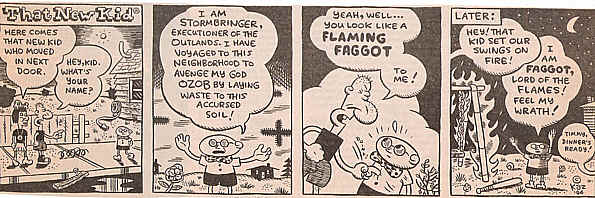
FEAR
Unless we know fear, we cannot know the courage it takes to step with one another into places of sadness, anger, or confusion to discover therein something important we have not known before about ourselves, about others, about the world. Only in such places of vulnerability and struggle can we find the strength born always, and only, through the labor of our power in mutual relation.
Encouraged, we are still afraid, embodied bearers of a sensual fear of what may happen if we go forth into the new or through the pain, but also of what may happen if we do not. Either way the dangers for us may be real. We may be frightened of failure or embarrassment, of isolation or loneliness, of opposition or punishment, of rejection or death. Our fear may threaten to consume us. But to deny it will harm us and others by allowing us to confuse dishonesty with personal safety and, in so doing, to stay out of touch with our relational power, one another, and ourselves.
-- Carter Heyward
FIRST TOUCH
Is this then a touch? quivering me to a new identity,
Flames and ether making a rush for my veins,
Treacherous tip of me reaching and crowding to help them,
My flesh and blood playing out lightning to strike
what is hardly different from myself,
On all sides prurient provokers stiffening my limbs,
Straining the udder of my heart for its withheld drip,
Behaving licentious toward me, taking no denial,
Depriving me of my best as for a purpose,
Unbuttoning my clothes, holding me by the bare waist,
Deluding my confusion with the calm of the sunlight and
pasture- fields,
Immodestly sliding the fellow-senses away,
They bribed to swap off with touch and go and graze at the
edges of me,
No consideration, no regard for my draining strength or my anger,
Fetching the rest of the herd around to enjoy them a while,
Then all uniting to stand on a headland and worry me.
The sentries desert every other part of me,
They have left me helpless to a red marauder,
They all come to the headland to witness and assist against me.
I am given up by traitors,
I talk wildly, I have lost my wits, I and nobody else am the
greatest traitor,
I went myself first to the headland, my own hands carried me there.
You villain touch! what are you doing? my breath is tight in
its throat,
Unclench your floodgates, you are too much for me.
-- Walt Whitman
FORTY
40 possible things to do * buy * be with * encounter * experience* explore * allow * share * find
for under $50.00 in the course of a delicious * adventurous * delightful* abundant * dramatic * silly * wonderful * happy birthday
1. a rock
2. a leaf
3. a card
4. a pen
5. the sun
6. a bath
7. a mango
8. some rain
9. a song
10. a pear
11. a poem
12. a new book
13. some flowers
14. a spider
15. the wind
16. a phone call to someone you love
17. a long walk
18. sesame noodles
19. window shopping
20. sitting on a park bench
21. listening to someone else's conversation
22. trying on something too expensive to buy
23. a magazine
24. peeing
25. laughing
26. a glass of water
27. give a panhandler a dollar
28. double chocolate ice cream cone
29. blowing bubbles
30. sit in the stairwell at the Whitney
31. the Cloisters
32. a bagel
33. a satisfying fart
34. a beautiful man walks by
35. plant some seeds
36. a hot bath not alone
37. a good movie
38. a warm hug
39. give something old away
40. love yourself for 24 hours nonstop
-- a birthday card from Andrew Ramer
GOD
"And you whose spirits are sad or unsure, try to remember the very best parts of your life, the loveliest feelings in your bodyself, occasions of bold delight and quiet confidence, moments of unambivalent commitment and unrestrained joy. Try to remember when you have believed passionately in something or someone, human or divine. Try to imagine that someone now believes in you because she trusts your loveliest feelings... commitments... confidence...joy.
She is your friend, whether or not you would have her, for she calls forth the best in you.
She comes in the knowledge that together you, she, and others embody a moving image of sacred power, a fresh wellspring of relational integrity. She goes with us as we are called forth to go, with one another, evoked by historical memory and by voices audible only to ears that can hear the power of God in history. Her name is love."
-- Carter Heyward
"God, a Poem"
A nasty surprise in a sandwich,
A drawing-pin caught in your sock,
The limpest of shakes from a hand which
You'd thought would be firm as a rock,
A serious mistake in a nightie,
A grave disappointment all round
Is all that you'll get from th'Almighty
Is all that you'll get underground.
Oh he said: "If you lay off the crumpet
I'll see you alright in the end.
Just hang on until the last trumpet.
Have faith in me, chum -- I'm your friend."
But if you remind him, he'll tell you:
"I'm sorry, I must have been pissed --
Though your name rings a sort of bell. You
Should have guessed that I do not exist.
"I didn't exist at Creation,
I didn't exist at the Flood,
And I won't be around for Salvation
To sort out the sheep from the cud --
"Or whatever the phrase is. The fact is
In soteriological terms
I'm a crude existential malpractice
And you are a diet of worms.
"You're a nasty surprise in a sandwich.
You're a drawing-pin caught in my sock.
You're the limpest of shakes from a hand which
I'd have thought would be firm as a rock,
"You're a serious mistake in a nightie,
You're a grave disappointment all round --
That's all that you are," says th'Almighty,
"And that's all that you'll be underground."
-- James Fenton
And so at last I saw Satan appear before me -- magnificent,
fully formed.
Feet first, with shining limbs, he glanced down from above
among the bushes,
And stood there erect, dark-skinned, with nostrils dilated
with passion;
(In the burning intolerable sunlight he stood, and I in the
shade of the bushes);
Fierce and scathing the effluence of his eyes, and scornful of
dreams and dreamers (he touched a rock hard by and it split with a sound like thunder);
Fierce the magnetic influence of his dusky flesh; his great
foot, well- formed, was planted firm in the sand -- with spreading toes;
"Come out," he said with a taunt, "Art thou afraid to meet me?"
And I answered not, but sprang upon him and smote him;
And he smote me a thousand times, and brashed and scorched and
slew me as with hands of flame;
And I was glad and sprang upon him again with another body--
And with another and another and again another;
And the bodies which I took on yielded before him, and were
like cinctures of flames upon me, but I flung them aside;
And the pains which I endured in one body were powers which I
wielded in the next; and I grew in strength, till at last I stood before him complete, with a body like his own and equal in might -- exultant in pride and joy.
Then he ceased, and said, "I love thee."
And lo! his form changed, and he leaned backwards and drew me
upon him,
And bore me up into the air, and floated me over the topmost
trees and the ocean, and round the curve of the earth under the moon --
Till we stood again in Paradise.
-- Edward Carpenter
"The Pope's Penis"
It hangs deep in his robes, a delicate
clapper at the center of a bell.
It moves when he moves, a ghostly fish in a
halo of silver seaweed, the hair
swaying in the dark and the heat -- and at night,
while his eyes sleep, it stands up
in praise of God.
HARRY KONDOLEON'S LAST POEM
The one who says she is all finished
Demonstrates on stage all that is gone.
You Leave A Lot To Be Desired
Is the name of the play.
It's a period piece.
Has what you'd expect.
Inherent bitterness against the world,
resurgencies of grudges,
lava the color of unreconciled childhoods.
The audience is appalled.
No man speaks.
Monologue -- no; diatribe -- no;
pretty discourse -- no; Greek -- not really,
But there is death.
Oh my dears, I have not been ushering
the aisles for these many decades
Without seeing the subtext.
***
The one who says she is all finished
Demonstrates on stage all that is gone.
It started as a novelty act
and blossomed into a full-fledged camellia
of blame
A pledge of indifference freshens the
deadness; I mean the sense of
no more happening, I mean the
act break where the producer
fake-jovially informs the audience
anything is possible -- goodnight
and thank you for your cooperation!
***
She is dressed like an unsculpted
slab of marble.
Monument to her art.
Insight scaling insight.
Emotional high. Eyes yet.
Unshorn, unshaven, unchic.
It's a look you see on
certain women after they've
finished a quart of whiskey.
But it isn't a story of alcoholism.
That would be too easy,
too dilutable.
(I'm drunk now.)
No, she is on another track altogether,
Like I said, about Demise.
It's a short trip really.
Not some Egyptian trek
Where you pass the Pyramids
that could have been your
monumental loves, your
sky-scraping career, your
complex progeny, all that
reassuring dust.
No, it's quick.
Like some car accident
recalled later in traction.
Protracted but sudden,
Cast before you know it.
Plaster of fixed persona.
I am not enjoying the performance.
It reminds me too much of my own
squashed bouquets.
Of dress rehearsals that turned out
to be the real thing and I
acted badly.
I'm alone and evaluating the
actress.
She can't be more than thirty. Forty?
Time hasn't been so cruel.
There are roles left, other
significant headdresses.
***
The one who says she is all finished
Demonstrates on stage all that is gone.
I am mesmerized
But I fall asleep.
I dream.
I'm in a corridor of bright talented women.
They implore me to write parts for them.
One steps forward.
I detect in her a distinction.
The stamp of completion.
God's inductee. Fatal audition.
By a trick of stage magic
She is seen in the finale
as a glowing new skeleton
Black light maybe, or trick scrims.
It is the special universal nakedness
the audience has paid for
despite their revulsion
despite their bourgeois outrage,
their half-price tickets
their reluctant catharsis
They think they're seeing God's handicraft,
Him at his worst,
I mean truest.
But God is no ghoul, I mean fool
It's just that he picks
his actresses carefully
So that when they are discarded
He has his own catharsis.
The title, You Leave A Lot To
Be Desired, puts him off
But he decides to be a sport about it
And not incinerate the theater.
Anyway, the actress has fallen to her knees
Palms open and outstretched.
Classical, I guess.
I guess she's about to die.
I came out tonight to learn something
about abandon.
I'm a bad student.
I drank and must have missed
the whole point to the show.
All the loss seems so petty now,
The actress who keeps saying she is all finished
Never seems done.
(Perhaps even in death she is afraid
of being out of work.)
I return to my wine-stained
garret
and light a candle.
It's chilly tonight
and the rain hasn't let up.
HOW TO LOVE YOURSELF
1. STOP ALL CRITICISM: Criticism never changes a thing. Refuse to criticize yourself. Accept yourself exactly as you are. Everybody changes. When you criticize yourself, your changes are negative. When you approve of yourself, your changes are positive.
2. DON'T SCARE YOURSELF: Stop terrorizing yourself with your thoughts. It's a dreadful way to live. Find a mental image that gives you pleasure, such as a mountain meadow or yellow roses, and immediately switch your scary thought to a pleasant thought.
3. BE GENTLE AND KIND AND PATIENT: Be gentle with yourself. Be kind to yourself. Be patient with yourself as you learn the new ways of thinking. Treat yourself as you would someone you really loved.
4. BE KIND TO YOUR MIND: Self-hatred is only hating your own thoughts. Don't hate yourself for having the thoughts. Gently change the thoughts.
5. PRAISE YOURSELF: Criticism breaks down the inner spirit. Praise builds it up. Praise yourself as much as you can. Tell yourself how well you are doing with every little thing.
6. SUPPORT YOURSELF: Find ways to support yourself. Reach out to friends and allow them to help you. It is being strong to ask for help when you need it.
7. BE LOVING OF YOUR NEGATIVES: Acknowledge that you created them to fulfill a need. Now you are finding new, positive ways to fulfill those needs. So lovingly release the old negative patterns.
8. TAKE CARE OF YOUR BODY: Learn about nutrition. What kind of fuel does your body need to have optimum energy and vitality? Learn about exercise. What kind of exercise can you enjoy? Cherish and revere the temple you live in.
9. MIRROR WORK: Look into your eyes often. Express this growing sense of love you have for yourself. Forgive yourself looking into the mirror. Talk to your parents looking into the mirror. Forgive them too. At least once a day say: "I love you, I really love you!" to your face in the mirror.
10. LOVE YOURSELF: Begin it now. Do the best you can.
-- Louise L. Hay
*
Is there one in all the world who does not desire to be
divinely beautiful?
To have the most perfect body -- unerring skill, strength,
limpid clearness of mind, as of the sunlight over the hills,
To radiate love wherever he goes, to move in and out, accepted?
The secret lies close to you, so close.
You are that person; it lies close to you, so close -- deep down
within --
But in Time it shall come forth and be revealed.
Not by accumulating riches, but by giving away what you have,
Shall you become beautiful;
You must undo the wrappings, not case yourself in fresh ones;
Not by multiplying clothes shall you make your body sound and
healthy, but rather by discarding them;
Not by multiplying knowledge shall you beautify your mind;
It is not the food that you eat that has to vivify you, but
you that have to vivify the food.
Always emergence, and the parting of veils for the hidden to
appear;
The child emerges from its mother's body, and out of that body
again in time another child.
When the body which thou now hast falls away, another body
shall be already prepared beneath,
And beneath that again another.
Always that which appears last in time is first, and the cause
of all -- and not that which appears first.
-- Edward Carpenter
IMAGINATION
The imagination has been so debased that imagination -- being imaginative -- rather than being the lynchpin of our existence now stands as a synonym for something outside ourselves like science fiction or some new use for tangerine slices on raw pork chops -- what an imaginative summer recipe -- and
Star Wars! So imaginative! And Star Trek -- so imaginative! And
Lord of the Rings -- all those dwarves -- so imaginative
-- The imagination has moved out of the realm of being our link, our most personal link, with our inner lives and the world outside that world -- this world we share. What is schizophrenia but a horrifying state where what's in here doesn't match up with what's out there?
Why has imagination become a synonym for style?
I believe that the imagination is the passport we crete to take us into the real world.
I believe the imagination is another phrase for what is most uniquely us.
Jung says the greatest sin is to be unconscious.
Our boy Holden [Caulfield, in Catcher in the Rye] says "What scares me most is the other guy's face -- it wouldn't be so bad if you could both be blindfolded -- most of the time the faces we face are not the other guys' but our own faces. And it's the worst kind of yellowness to be so scared of yourself you put blindfolds on rather than deal with yourself..."
To face ourselves.
That's the hard thing.
The imagination.
That's God's gift to make the act of self-examination bearable.
-- John Guare, Six Degrees of Separation
INSOMNIA
"Prayer to Morphos"
I was supposed to be on fire
before the Jamaica switch turned me livid
in front of smirking conductors. I didn't care.
I missed you and your big butt
and your unrevealing pleasantness
and lapping at your liquid.
Now it will be weeks and the phone
doesn't do it for me.
Late at night I get morose. It's judgment day
at midnight. Everything weighed.
Everything found wanting.
O for a prayer that would revive simple love,
the love on a sunny afternoon for chocolate brownies,
the uncomplicated love of a cat for a soft surface
to lie on for hours, the love of a young man
from the pimple age for assault by guitar.
I'm trying too hard. Let me go.
Let me sleep. Let me sleep.
Let me sleep and dream and not have to pee
more than once.
let the songs stay on the records and tapes.
Don't wake me up before daylight.
It's a full moon tonight hidden in clouds.
God's gone to the neighbors for coffee
but they're not home so he sits on their porch
trimming his fingernails and hoping
a dog will come by for company.
He eats a ham sandwich from his pocket
and waits for morning.
-- Don Shewey
INTELLECTUAL
I understand the vocation of the intellectual as trying to turn easy answers into critical questions, and ask these critical questions to those with power...The quest for truth, the quest for the good, the quest for the beautiful, for me, presupposes allowing suffering to speak, allowing victims to be visible, and allowing social misery to be put on the agenda of those with
power.
-- Cornel West
THE JOY OF FAILURE
There is a veritable San Andreas Fault in the modern American psyche: the personality's wish to have power over experience, to control all events and consequences, and the soul's wish to have power
through experience, no matter what that may be...For the personality, bankruptcy or failure may be a disaster, for the soul it may be grist for its strangely joyful mill and a condition it has been secretly engineering for
years.
-- David Whyte
KISS
"American Wedding"
In america,
I place my ring
on your cock
where it belongs.
No horsemen
bearing terror,
no soldiers of doom
will swoop in
and sweep us apart.
They're too busy
looting the land
to watch us.
They don't know
we need each other
critically.
They expect us to call in sick,
watch television all night,
die by our own hands.
They don't know
we are becoming powerful.
Every time we kiss
we confirm the new world coming.
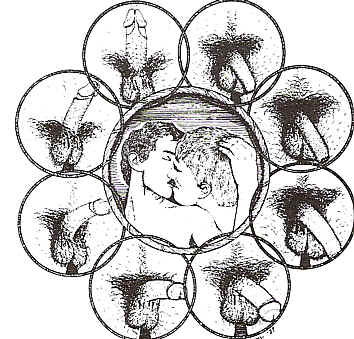
What the rose whispers
before blooming
I vow to you.
I give you my heart,
a safe house.
I give you promises other than
milk, honey, liberty.
I assume you will always
be a free man with a dream.
In america,
place your ring
on my cock
where it belongs.
Long may we live
to free this dream.
-- Essex Hemphill
LIFE CLASS
In the Dreaming Back, the spirit is compelled to live over and over again the events that had most moved it; there can be nothing new, but the old events stand forth in a light which is dim or bright according to the intensity of the passion that accompanied them. They occur in the order of their intensity or luminosity, the more intense first, and the painful are commonly the more intense, and repeat themselves again and again.
In The Return, upon the other hand, the spirit must live through past events in the order of their occurrence, because it is compelled by the celestial body to trace every passionate event to its cause until all are related and understood, turned into knowledge, made a part of itself.
Sometimes, however, a single relationship will repeat itself, turning in revolving wheel again and again, especially where there has been strong sexual passion. All such passions contain cruelty and deceit and this antithetical cruelty and deceit must be expiated in primary suffering and submission, or the old tragedy will be repeated.
-- William Butler Yeats
To walk down the street
With a mean look on my face
A cigarette in one hand
A toothpick in the other
To alternate between the cigarette and the toothpick
Ah, my friends -- that's life!
--Maria Irene Fornes
LOST
Stand still. The trees ahead and bushes beside you
Are not lost. Wherever you are is called Here,
And you must treat it as a powerful stranger,
Must ask permission to know it and be known.
The forest breathes. Listen. It answers,
It have made this place around you,
If you leave it you may come back again, saying Here.
No two trees are the same to Raven.
No two branches are the same to Wren.
If what a tree or a bush does is lost on you,
You are surely lost. Stand still. The forest knows
Where you are. You must let it find you.
-- Native American elder (English version by David Wagoner)
LOVE
The flute of interior time is played whether we hear it or not,
What we mean by "love" is its sound coming in.
When love hits the farthest edge of excess, it reaches a wisdom.
And the fragrance of that knowledge!
It penetrates our thick bodies,
it goes through walls --
Its network of notes has a structure as if a million suns were
arranged inside.
This tune has truth in it.
Where else have you heard a sound like this?
-- Kabir (translated by Robert Bly
"LOVE AS THE PRACTICE OF FREEDOM"
In this society, there is no powerful discourse on love emerging either from politically progressive radicals or from the Left. The absence of a sustained focus on love in progressive circles arises from a collective failure to acknowledge the needs of the spirit and an overdetermined emphasis on material concerns. Without love, our efforts to liberate ourselves and our world community from oppression and exploitation are doomed. As long as we refuse to address fully the place of love in struggles for liberation we will not be able to create a culture of conversion where there is a mass turning away from an ethic of domination.
Without an ethic of love shaping the direction of our political vision and our radical aspirations, we are often seduced, in one way or the other, into continued allegiance to systems of domination -- imperialism, sexism, racism, classism. It has always puzzled me that women and men who spend a lifetime working to resist and oppose one form of domination can be systematically supporting another. I have been puzzled by powerful visionary black male leaders who can speak and act passionately in resistance to racial domination and accept and embrace sexist domination of women, by feminist white women who work daily to eradicate sexism but who have major blind spots when it comes to acknowledging and resisting racism and white supremacist domination of the planet. Critically examining these blind spots, I conclude that many of us are motivated to move against domination solely when we feel our self-interest directly threatened. Often, then, the longing is not for a collective transformation of society, an end to politics of dominations, but rather simply for an end to what we feel is hurting us. This is why we desperately need an ethic of love to intervene in our self-centered longing for change. Fundamentally, if we are only committed to an improvement in that politic of domination that we feel leads directly to our individual exploitation or oppression, we not only remain attached to the status quo but act in complicity with it, nurturing and maintaining those very systems of domination. Until we are all able to accept the interlocking, interdependent nature of systems of domination and recognize specific ways each system is maintained, we will continue to act in ways that undermine our individual quest for freedom and collective liberation struggle.
The ability to acknowledge blind spots can emerge only as we expand our concern about politics of domination and our capacity to care about the oppression and exploitation of others. A love ethic makes this expansion possible. The civil rights movement transformed society in the United States because it was fundamentally rooted in a love ethic. No leader has emphasized this ethic more than Martin Luther King, Jr. He had the prophetic insight to recognize that a revolution built on any other foundation would fail. Again and again, King testified that he had "decided to love" because he believed deeply that if we are "seeking the highest good" we "find it through love" because this is "the key that unlocks the door to the meaning of ultimate reality." And the point of being in touch with a transcendent reality is that we struggle for justice, all the while realizing that we are always more than our race, class, or sex. When I look back at the civil rights movement which was in many ways limited because it was a reformist effort, I see that it had the power to move masses of people to act in the interest of racial justice -- and because it was profoundly rooted in a love ethic.
The sixties Black Power movement shifted away from that love ethic. The emphasis was now more on power. And it is not surprising that the sexism that had always undermined the black liberation struggle intensified, that a misogynist approach to women became central as the equation of freedom with patriarchal manhood became a norm among black political leaders, almost all of whom were male. Indeed, the new militancy of masculinist black power equated love with weakness, announcing that the quintessential expression of freedom would be the willingness to coerce, do violence, terrorize, indeed utilize the weapons of domination. This was the crudest embodiment of Malcolm X's bold credo "by any means necessary."
On the positive side, Black Power movement shifted the focus of black liberation struggle from reform to revolution. This was an important political development, bringing with it a stronger anti-imperialist, global perspective. However, masculinist sexist biases in leadership led to the suppression of the love ethic. Hence progress was made even as something valuable was lost. While King had focused on loving our enemies, Malcolm called us back to ourselves, acknowledging that taking care of blackness was our central responsibility. Even though King talked about the importance of black self-love, he talked more about loving our enemies. Ultimately, neither he nor Malcolm lived long enough to fully integrate the love ethic into a vision of political decolonization that would provide a blueprint for the eradication of black self-hatred.
Black folks entering the realm of racially integrated, American life because of the success of civil rights and black power movement suddenly found we were grappling with an intensification of internalized racism. The deaths of these important leaders (as well as liberal white leaders who were major allies in the struggle for racial equality) ushered in tremendous feelings of hopelessness, powerlessness, and despair. Wounded in that space where we would know love, black people collectively experienced intense pain and anguish about our future. The absence of public spaces where that pain could be articulated, expressed, shared meant that it was held in -- festering, suppressing the possibility that this collective grief would be reconciled in community even as ways to move beyond it and continue resistance struggle would be envisioned. Feeling as though "the world had really come to an end," in the sense that a hope had died that racial justice would become the norm, a life-threatening despair took hold in black life. We will never know to what extent the black masculinist focus on hardness and toughness served as a barrier preventing sustained public acknowledgement of the enormous grief and pain in black life. In
World as Lover, World as Self, Joanna Macy emphasizes in her chapter on "Despair Work" that
the refusal to feel takes a heavy toll. Not only is there an impoverishment of our emotional and sensory life...but this psychic numbing also impedes our capacity to process and respond to information. The energy expended in pushing down despair is diverted from more creative uses, depleting the resilience and imagination needed for fresh visions and strategies.
If black folks are to move forward in our struggle for liberation, we must confront the legacy of this unreconciled grief, for it has been the breeding ground for profound nihilistic despair. We must collectively return to a radical political vision of social change rooted in a love ethic and seek once again to convert masses of people, black and nonblack.
A culture of domination is anti-love. It requires violence to sustain itself. To choose love is to go against the prevailing values of the culture. Many people feel unable to love either themselves or others because they do not know what love is. Contemporary songs like Tina Turner's "What's Love Got to Do With It" advocate a system of exchange around desire, mirroring the economics of capitalism: the idea that love is important is mocked...Though many folks recognize and critique the commercialization of love, they see no alternative. Not knowing how to love or even what love is, many people feel emotionally lost; others search for definitions, for ways to sustain a love ethic in a culture that negates human value and valorizes materialism.
The sales of books focusing on recovery, books that seek to teach folks ways to improve self-esteem, self-love, and our ability to be intimate in relationships, affirm that there is public awareness of a lack in most people's lives. M. Scott Peck's self-help book
The Road Less Traveled is enormously popular because it addresses that lack.
Peck offers a working definition for love that is useful for those of us who would like to make a love ethic the core of all human interaction. He defines love as "the will to extend one's self for the purpose of nurturing one's own or another's spiritual growth." Commenting on prevailing cultural attitudes about love, Peck writes:
Everyone in our culture desires to some extent to be loving, yet many are in fact not loving. I therefore conclude that the desire to love is not itself love. Love is as love does. Love is an act of will -- namely both an intention and an action. Will also implies choice. We do not have to love. We choose to love.
His words echo Martin Luther King's declaration "I have decided to love," which also emphasizes choice. King believed that love is "ultimately the only answer" to the problems facing this nation and the entire planet. I share that belief and the conviction that it is in choosing love, and beginning with love as the ethical foundation for politics, that we are best positioned to transform society in ways that enhance the collective good.
It is truly amazing that King had the courage to speak as much as he did about the transformative power of love in a culture where such talk is often seen as merely sentimental. In progressive political circles, to speak of love is to guarantee that one will be dismissed or considered naive. But outside those circles there are many people who openly acknowledge that they are consumed by feelings of self-hatred, who feel worthless, who want a way out. Often they are too trapped by paralyzing despair to be able to engage effectively in any movement for social change. However, if the leaders of such movements refuse to address the anguish and pain of their lives, they will never be motivated to consider personal and political recovery. Any political movement that can effectively address these needs of the spirit in the context of liberation struggle will succeed.
In the past, most folks both learned about and tended the needs of the spirit in the context of religious experience. The institutionalization and commercialization of the church has undermined the power of religious community to transform souls, to intervene politically. Commenting on the collective sense of spiritual loss in modern society, Cornel West asserts:
There is a pervasive impoverishment of the spirit in American society, and especially among Black people. Historically, there have been cultural forces and traditions, like the church, that held cold-heartedness and mean-spiritedness at bay. However, today's impoverishment of the spirit means that this coldness and meanness is becoming more and more pervasive. The church kept these forces at bay by promoting a sense of respect for others, a sense of solidarity, a sense of meaning and value which would usher in the strength to battle against evil.
Life-sustaining political communities can provide a similar space for the renewal of the spirit. That can happen only if we address the needs of the spirit in progressive political theory and practice.
Often when Cornel West and I speak with large groups of black folks about the impoverishment of spirit in black life, the lovelessness, sharing that we can collectively recover ourselves in love, the response is overwhelming. Folks want to know how to begin the practice of loving. For me that is where education for critical consciousness has to enter. When I look at my life, searching it for a blueprint that aided me in the process of decolonization, of personal and political self-recovery, I know that it was learning the truth about how systems of domination operate that helped, learning to look both inward and outward with a critical eye. Awareness is central to the process of love as the practice of freedom. Whenever those of us who are members of exploited and oppressed groups dare to critically interrogate our locations, the identities and allegiances that inform how we live our lives, we begin the process of decolonization. If we discover in ourselves self-hatred, low self-esteem, or internalized white supremacist thinking and we face it, we can begin to heal. Acknowledging the truth of our reality, both individual and collective, is a necessary state for personal and political growth. This is usually the most painful stage in the process of learning to love -- the one many of us seek to avoid. Again, once we choose love, we instinctively possess the inner resources to confront that pain. Moving through the pain to the other side we find the joy the freedom of spirit that a love ethic brings.
Choosing love we also choose to live in community, and that means that we do not have to change by ourselves. We can count on critical affirmation and dialogue with comrades walking a similar path. African American theologian Howard Thurman believed that we best learn low as the practice of freedom in the context of community. Commenting on this aspect of his work in the essay "Spirituality out on The Deep," Luther Smith reminds us that Thurman felt the United States was given to diverse groups of people by the universal life force as a location for the building of community. Paraphrasing Thurman, he writes: "Truth becomes true in community. The social order hungers for a center (i.e., spirit, soul) that gives it identity, power, and purpose. America, and all cultural entities, are in search of a soul." Working within community, whether it be sharing a project with another person, or with a larger group, we are able to experience joy in struggle. That joy needs to be documented. For if we only focus on the pain, the difficulties which are surely real in any process of transformation, we only show a partial picture.
A love ethic emphasizes the importance of service to others. Within the value system of the United States any task or job that is related to "service" is devalued. Service strengthens our capacity to know compassion and deepens our insight. To serve another I cannot see them as an object, I must see their subjecthood. Sharing the teaching of Shambala warriors, Buddhist Joanna Macy writes that we need weapons of compassion and insight.
You have to have compassion because it gives you the juice, the power, the passion to move. When you open to the pain of the world you move, you act. But that weapon is not enough. It can burn you out, so you need the other -- you need insight into the radical interdependence of all phenomena. With that wisdom you know that it is not a battle between good guys and bad guys, but that the line between good and evil runs through the landscape of every human heart. With insight into our profound interrelatedness, you know that actions undertaken with pure intent have repercussions throughout the web of life, beyond what you can measure or discern.
Macy shares that compassion and insight can "sustain us as agents of wholesome change" for they are "gifts for us to claim now in the healing of our world." In part, we learn to love by giving service. This is again a dimension of what Peck means when he speaks of extending ourselves for another.
The civil rights movement had the power to transform society because the individuals who struggle along and in community for freedom and justice wanted these gifts to be for all, not just the suffering and the oppressed. Visionary black leaders such as Septima Clark, Fannie Lou Hamer, Martin Luther King, Jr., and Howard Thurman warned against isolationism. They encouraged black people to look beyond our own circumstances and assume responsibility for the planet. This call for communion with a world beyond the self, the tribe, the race, the nation, was a constant invitation for personal expansion and growth. When masses of black folks started thinking solely in terms of "us and them," internalizing the value system of white supremacist capitalist patriarchy, blind spots developed, the capacity for empathy needed for the building of community was diminished. To heal our wounded body politic we must reaffirm our commitment to a vision of what King referred to in the essay "Facing the Challenge of a New Age" as a genuine commitment to "freedom and justice for all." My heart is uplifted when I read King's essay; I am reminded where true liberation leads us. It leads us beyond resistance to transformation. King tells us that "the end is reconciliation, the end is redemption, the end is the creation of the beloved community." The moment we choose to love we begin to move against domination, against oppression. The moment we choose to love we begin to move towards freedom, to act in ways that liberate ourselves and others. That action is the testimony of love as the practice of freedom.
-- bell hooks
MASTERY
Beware how thou seekest this for thyself and that for thyself. I do not say Seek not; but Beware how thou seekest.
For a soldier who is going a campaign does not seek what fresh furniture he can carry on his back, but rather what he can leave behind;
Knowing well that every additional thing which he cannot freely use and handle is an impediment to him.
So if thou seekest fame or ease or pleasure or aught for thyself, the image of that thing which thou seekest will come and cling to thee -- and thou wilt have to carry it about;
And the images and powers which thou hast thus evoked will gather round and form for thee a new body -- clamoring for sustenance and satisfaction;
And if thou art not able to discard this image now, thou wilt not be able to discard that body then: but wilt have to carry it about.
Beware then lest it become thy grave and thy prison -- instead of thy winged abode, and palace of joy.
For (over and over again) there is nothing that is evil except because a man has not mastery over it; and there is no good thing that is not evil if it have mastery over a man;
And there is no passion or power, or pleasure or pain, or created thing whatsoever, which is not ultimately for man and for his use -- or which he need be afraid of, or ashamed at.
The ascetics and the self-indulgent divide things into good and evil -- as it were to throw away the evil;
But things cannot be divided into good and evil, but all are good so soon as they are brought into subjection.
And seest thou not that except for Death thou couldst never overcome Death --
For since by being a slave to things of sense thou hast clothed thyself with a body which thou art not master of, thou wert condemned to a living tomb were that body not to be destroyed.
But now through pain and suffering out of this tomb shalt thou come; and through the experience thou hast acquired shalt build thyself a new and better body;
And so on many times, till thou spreadest wings and hast all powers diabolic and angelic concentred in thy flesh.
-- Edward Carpenter
MEDIA
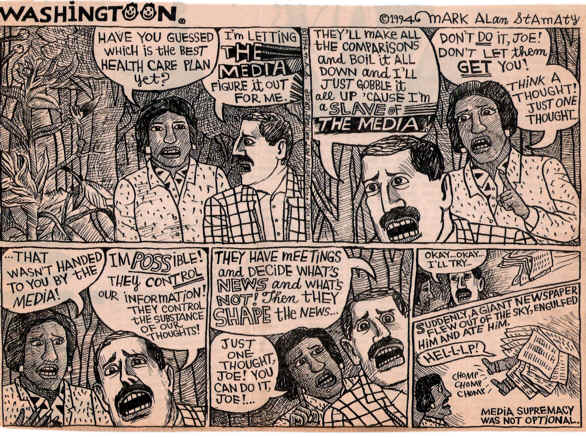
MOTHER

MUTUALITY
It is the aim of God herself: to create the friendship in which the cosmos is originally imaged. I mean by "original" not simply first, but purposive: We are created originally for (the purpose of) friendship.
To generate friendship -- embodied/incarnate mutuality -- is the purpose of a sexual theology and ethics, just as it is the heart of a liberating God. We need to understand more about what mutuality is, and what it is not, to realize what is involved in our liberation.
As Margaret Huff and others have noted, mutuality is not merely reciprocity, a quid pro quo give and take of benefits or sexual pleasure. Nor is mutuality a way of being in relation without anger or conflict. It is a process of relational movement that most often is charged with tension. It is a process in which two or more people are struggling to share power between/among ourselves.
Mutuality involves wrestling more fully to embody friendship. It involves learning to stand and walk together and to recognize and honor the differences we bring to our common ground. It requires risking through fear, not without it, to be friends. It means working together on our frustrations, hurt, anger, confusion, and conflicts.
Mutuality is a process of getting unstuck, of moving through impasses, of coming into our power together. It is the way of liberation, of calling forth the best in one another and, in so doing, of empowering one another to be who we are at our best.
Mutuality is the process by which we create and liberate one another. It is not only about lesbian or gay relationships. (Some of us have tended to idealize the mutuality in lesbian bonding.) It is about heterosexual relating, it is about black-white, Hispanic-Anglo, and Asian-European relating.
The erotic is not only movement toward mutuality. It involves a yearning or longing for mutuality. "Yearning" implies a desire for something we don't yet have, don't quite know how to participate in, or don't experience fully as ours. The term "longing" may further sharpen the eschatalogical movement of the erotic, in which we long for something that, in mutual relation, is both yet -- and not yet, both now -- and coming. Such relationships may be charged with tensions steeped in unequal power dynamics. Mutuality often involves working out inequality -- in work, in love, in sex.
-- Carter Heyward
*
"The Solution"
Finally they got the Singles problem under control, they made it scientific. They opened huge Sex Centers -- you could simply go and state what you want and they would find you someone who wanted that too. You would stand under a sign saying
I Like to Be Touched and Held and when someone came and stood under the sign saying
I Like to Touch and Hold they would send the two of you off together.
At first it went great. A steady stream of people under the sign I Like to Give Pain
paired up with the steady stream of people from under I Like to Receive Pain. Foreplay Only -- No Orgasm
found its adherents, and Orgasm Only -- No Foreplay matched up its believers. A loyal Berkeley, California, policeman stood under the sign
Married Adults, lights Out, Face to Face, Under a Sheet, because that's the only way it was legal in Berkeley -- but he stood there a long time in his lonely blue law coat. And the man under
I Like to Be Sung to While Bread Is Kneaded on My Stomach had been there weeks without a reply.
Things began to get strange. The Love Only -- No Sex was doing fine; the
Sex Only -- No Love was doing really well, pair after pair walking out together like wooden animals off a child's ark, but the line for
38D or Bigger was getting unruly, shouting insults at the line for
8 Inches or Longer, and odd isolated signs were springing up everywhere,
Retired Schoolteacher and Parakeet -- No Leather; One Rm/No Bath/View of Sausage Factory.
The din rose in the vast room. The line under I Want to Be Fucked Senseless
was so long that portable toilets had to be added and a minister brought in for deaths, births, and marriages on the line. Over under
I Want to Fuck Senseless -- no one, a pile of guns. A hollow roaring filled the enormous gym. More and more people began to move over to
Want to Be Fucked Senseless. the line snaked around the gym, the stadium, the whole town, out into the fields. More and more people joined it, until
Fucked Senseless stretched across the nation in a huge wide belt like the Milky Way, and since they had to name it they named it, they called it the American Way.
-- Sharon Olds
NOT KNOWING
The cloud of unknowing has to be part of the deal of spirituality. You have to be willing to live in the unknowing. Part of faith is leaping over the chasm of doubt. If you're not afraid, you're not brave.
-- Tony Kushner
Sell your cleverness
and buy bewilderment.
Cleverness is mere opinion,
bewilderment is intuition.
-- Rumi
What distinguishes the twentieth century is that each individual life is a daily progression though a concrete but fluctuating landscape of the psyche's projections. Technology projects the subconscious into countless
things, and thus duplicates the processes of the subconscious's greatest artifact, the dream. The surreality, simultaneity, sexuality, and instantaneous change that once occurred only in our dreams now also occur all around us.
So the condition of our subconscious is now also the condition of this physical environment we've built for ourselves.
Now we reel between dream and dream. Between the dreams of our sleep that speak to us alone and the dreamscape of the waking world, in which we make our way through millions of dream pieces colliding around us in a collective slam-dance.
It was easy (or so it seems now) to love the world as it used to be, the world of rigid boundaries. That world was a world, it held still long enough to be a world and gave us time to learn to love it. But loving this scary state of flux? We want to love it, we have in us to give it, but we are frightened and do not know how. Yet daily life hinges on what we are and are not able to love. So this craving not for love but to love, to be able to love what's around one -- it twists itself into a mere, and futile, search for certainty.
-- Michael Ventura
OLD
"Waiting in Line"
You the very old, I have come
to the edge of your country and looked across,
how your eyes warily look into mine
when we pass, how you hesitate when
we approach a door. Sometimes
I understand how steep your hills
are, and your way of seeing the madness
around you, the careless waste of the calendar,
the rush of people on buses. I have
studied how you carry packages,
balancing them better, giving them attention.
I have glimpsed from within the gray-eyed look
at those who push, and occasionally even I
can achieve your beautiful bleak perspective
on the loud, the inattentive, shoving boors
jostling past you toward their doom.
With you, from the pavement I have watched
the nation of the young, like jungle birds
that scream as they pass, or gyrate on playgrounds,
their frenzied bodies jittering with the disease
of youth. Knowledge can cure them. But
not all at once. It will take time.
There have been evenings when the light
has turned everything silver, and like you
I have stopped at a corner and suddenly
staggered with the grace of it all: to have
inherited all this, or even the bereavement
of it, and finally being cheated! -- the chance
to stand on a corner and tell it goodbye!
Every day, every evening, every
abject step or stumble has become heroic: --
You others, we the very old have a country.
A passport costs everything there is.
-- William Stafford
THE PATH
If we can see the path ahead laid out for us, there is a good chance it is not our path; it is probably someone else's we have substituted for our own.
-- David Whyte
Everyone who is destined to have a spiritual transformation comes to the journey with a wound as large as God. They have to, to go through it. Very few people are going to undertake the massive stripping it entails unless there is something tremendously painful urging them on. There are very few people who become advanced mystics because they simply feel happy on Sunday afternoons.
-- Andrew Harvey
Listen! I will be honest with you,
I do not offer the old smooth prizes, but offer rough new prizes,
These are the days that must happen to you:
You shall not heap up what is call'd riches,
You shall scatter with lavish hand all that you earn or achieve,
You but arrive at the city to which you were destin'd, you
hardly settle yourself to satisfaction before you are call'd by an irresistible call to depart,
You shall be treated to the ironical smiles and mockings of
those who remain behind you,
What beckonings of love you receive you shall only answer with
passionate kisses of parting,
You shall not allow the hold of those who spread their reach'd
hands toward you.
-- Walt Whitman
POETIC TERRORISM
Weird dancing in all-night computer-banking lobbies. Unauthorized pyrotechnic displays. Land-art, earthworks as bizarre alien artifacts strewn in State Parks. Burglarize houses but instead of stealing, leaving Poetic-Terrorist objects. Kidnap someone & make them happy.
Pick someone at random & convince them they're the heir to an enormous, useless & amazing fortune -- say 5000 square miles of Antarctica, or an aging circus elephant, or an orphanage in Bombay, or a collection of alchemical manuscripts. Later they will come to realize that for a few moments they believed in something extraordinary, & will perhaps be driven as a result to seek out some more intense mode of existence.
Bolt up brass commemorative plaques in places (public or private) where you have experienced a revelation or had a particularly fulfilling sexual experience.
Go naked for a sign.
Organize a strike in your school or workplace on the grounds that it does not satisfy your need for indolence & spiritual beauty.
Graffiti-art loaned some grace to ugly subways & rigid public monuments -- PT-art can also be created for public places: poems scrawled in courthouse lavatories, small fetishes abandoned in parks & restaurants, xerox-art under windshield wipes of parked cars, Big Character Slogans pasted on playground walls, anonymous letters mailed to random or chosen recipients (mail fraud), pirate radio transmission, wet cement...
The audience reaction or aesthetic-shock produced by PT ought to be at least as strong as the emotion of terror -- powerful disgust, sexual arousal, superstitious awe, sudden intuitive breakthrough, dada-esque angst -- no matter whether the PT is aimed at one person or many, no matter whether it is "signed" or anonymous, if it does not change someone's life (aside from the artist) it fails.
PT is an act in a Theater of Cruelty which has no stage, no rows of seats, no tickets & no walls. In order to work at all, PT must categorically be divorced form all conventional structures for art consumption (galleries, publications, media). Even the guerilla Situationist tactics of street theater are perhaps too well known & expected now.
An exquisite seduction carried out not only in the cause of mutual satisfaction but also as a conscious act in a deliberately beautiful life -- may be the ultimate PT. The PTerrorist behaves like a confidence-trickster whose aim is not money but CHANGE.
Don't do PT for other artists, do it for people who will not realize (at least for a few moments) that what you have done is art. Avoid recognizable art-categories, avoid politics, don't stick around to argue, don't be sentimental; be ruthless, take risks, vandalize only what must be defaced, do something children will remember all their lives -- but don't be spontaneous unless the PT muse has possessed you.
Dress up. Leave a false name. Be legendary. The best PT is against the law, but don't get caught. Art as crime; crime as art.
-- Hakim Bey
POSSIBILITY
The most important thing in life is a sense of possibility, and you simply can't have it with less than ten thousand dollars in your pocket.
-- Rocco Landesman
PROMISCUITY
"Sex Without Love"
How do they do it, the ones who make love
without love? Beautiful as dancers,
gliding over each other like ice-skaters
over the ice, fingers hooked
inside each other's bodies, faces
red as steak, wine, wet as the
children at birth whose mothers are going to
give them away. How do they come to the
come to the come to the God come to the
still waters, and not love
the one who came there with them, light
rising slowly as steam off their joined
skin? These are the true religious,
the purists, the pros, the ones who will not
accept a false Messiah, love the
priest instead of the God. They do not
mistake the lover for their own pleasure,
they are like great runners: they know they are alone
with the road surface, the cold, the wind,
the fit of their shoes, their over-all cardio-
vascular health -- just factors, like the partner
in the bed, and not the truth, which is the
single body alone in the universe
against its own time.
-- Sharon Olds
Just for the record, I think promiscuity has its place. I sometimes long nostalgically for what was good about the gay sexual revolution of the seventies -- the playfulness and adventure. The point is, whatever sex one chooses to engage in these days, it should be safer sex and, I believe, it should proceed from a loving instinct to communicate with another human being, rather than being about merely scratching a physical itch, with no regard for the humanity of the individual you're scratching the itch
with.
-- Michael Callen
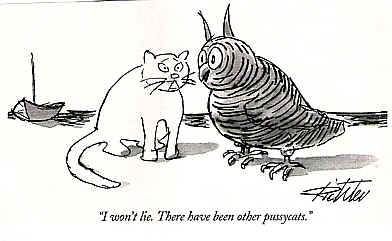
PROVERBS
In the long run men hit only what they aim at. Therefore, though they should fail immediately, they had better aim at something high.
-- Henry David Thoreau
Give a man some love -- you feed him for a day.
Teach a man to love -- you feed him for life.
-- Mark O'Donnell
Everybody needs three things: someone to love, something to do, and something to look forward to.
-- Anonymous
Poetry is the art of overhearing ourselves say things from which it is impossible to retreat.
-- David Whyte
Wisdom is having things right in your life and knowing why.
-- William Stafford
The tygers of wrath are wiser than the horses of instruction.
He who desire but acts not, breeds pestilence.
You never know what is enough unless you know what is more
than enough.
-- William Blake
A person doesn't walk among thorns for nothing. He's either chasing a snake or a snake is chasing him.
-- Zen proverb
Any man or woman who uses sex to get something is not interested in sex but in power.
-- Ginette Paris
Change everything, except what you love.
Love everything that changes your mind.
-- James Broughton
Q & A
Q: How do you make God laugh?
A: Tell him your plans.
-- A.A. joke
REVOLUTIONARY PATIENCE
The christian fathers...have believed that loving is hard because, in order to love, we must renounce or at least control our erotic passion.
In fact, loving is hard because learning to share our passion, the exuberant yearnings of our erotic/sacred power, requires of us, in Dorothee Solle's words, "revolutionary patience" with one another, not renunciation of ourselves or others. It takes a great deal of time and love for us to learn how to let go of our senses of separateness, isolation, and self-control, and risk not only reaching out to touch others but also allowing ourselves to be touched deeply by them.
We need revolutionary patience, with ourselves and with one another, if we are to help each other learn to respect and cross the boundaries of our bodyselves, the qualities of personal integrity that render each of us unique and, in this sense, separate from all others. We are not the same, not in the beginning, not in the end. We are not lone, not a merger, not a unity of look-alike-think-alike-act-alike-be-alike.
In the beginning is the relation, not sameness.
In the beginning is tension and turbulence, not easy peace.
In the beginning our erotic power moves us to touch, not take over; transform, not subsume. We are empowered by a longing not to blur the contours of our differences, but rather to reach through the particularities of who we are toward our common strength, our shared vulnerability, and our relational pleasure.
Calling us forth, the Holy One blesses us with one another's presence and, through the relation, with sharper senses of ourselves as individuals.
Learning these relational lessons with one another is the only way we can learn them. It is the only way we can experience the love of God, the creative energy of our godding, the erotic as sacred power.
-- Carter Heyward
RITUAL
The modern seeker of ritual primarily acknowledges that he or she is wounded, or hollowed out, or emptied of his or her vital substance to the point that the individual is almost disgusted with the present state of his or her life.
These wounds are evidence of the need to enter into a special creative process. They are the language with which entry into the realm of ritual is possible. As long as one does not deploy special energy to repress and deny these wounds, but rather contains them creatively -- that is, in ritual -- then one is working on oneself as a potential survivor of the holocaust and the tyranny of Progress. I mean to say that the hurt that a person feels in the midst of this modern culture should be taken as a language spoken to himself or herself by the body. And the meaning of such a language is found in doing something about the part of oneself that is not acknowledged.
***
Language in itself does not create or provide a space in which the natural and the supernatural world can safely migrate into this world. Sometimes, the words into which we want to put certain sacred spirits are a deadly virus to those very spirits. So rather than let themselves be damaged by us, these spirits damage us instead.
***
We need ritual because it is an expression of the fact that we recognize the difficulty of creating a different and special kind of community. A community that doesn't have a ritual cannot exist. A corporate community is not a community. It's a conglomeration of individuals in the service of an insatiable soulless entity. What we need is to be able to come together with a constantly increasing mindset of wanting to do the right thing, even though we know very well that we don't know how nor where to start. This seemingly frightening position is amusing to the spirit that watches over you. Your desire alone is strong enough to guide you along the path. But, of course, it is useful to know certain elemental steps such as invoking the Spirit of the Ancestors or of Nature. Knowing what spirit to invoke and what to do with that spirit depends on your ability to stay focused on your purpose. You must be willing to speak of your inabilities, your clumsiness. As Robert Bly would say, you must walk your limp in order to stay with your purpose. This is important for you to truly shine, to really be at home with yourself in ritual and in community."
Any ritual designed to satisfy an ego is a ritual for show, and therefore is a spiritual farce. But any ritual in which the persons involved invite the spirits to come and help in something that humans are not capable of handling by themselves or in which humans honor gift-giving from the divine, there is a likelihood of the ritual working.
-- Malidoma Some, Ritual: Power, Healing, and Community
RUDE

THE RULES
A long time ago I learned that being alive meant playing by certain rules. Everyone knows that the specific choice of rules is an arbitrary one, but we agree on them to give ourselves something to focus on. One of the rules is that certain basic things -- feelings, other people and responsibilities -- are real. When they slip away, the walls cave in and there's nothing left but anger at what you gave up along the way just to play along.
-- Sarah Schulman, After Delores
SACRED INTIMATE
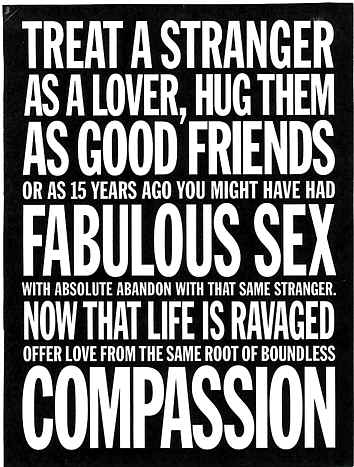
-- John Giorno
THE SECRET OF LIFE
A man climbed to the top of the Himalayan peaks and found a guru waiting in his cave and asked him what was the secret of life. And this particular guru's answer was something like "wise action."
And the man asked, "Well, where does wise action come from?"
And the guru answered, "The secret of life is to live wisely."
The man said, "Well, how do you learn to live wisely?"
The guru said, "From experience."
And the man said, "Well, how do you get experience?"
And the guru said, "By living unwisely ."
-- Jack Kornfield

SEX
Sex is just the beginning,
not the end.
But if you miss the beginning,
you will miss the end also.
-- Bhagwan Shree Rajneesh
*
The height of sexual love, coming upon us of itself, is one of the most total experiences of relationship to the other of which we are capable, but prejudice and insensitivity have prevented us from seeing that in any other circumstances such delight would be called mystical ecstasy. For what lovers feel for each other in this moment is no other than adoration in its full religious sense, and its climax is almost literally the pouring of their lives into each other. Such adoration, which is due only to God, would indeed be idolatrous, were it not that in that moment love takes away illusion and shows the beloved for what he or she in truth is -- not the socially pretended person but the naturally divine.
-- Alan Watts, Nature, Man, and Woman
Don't trip
on the leaps of your life
Jump
The traces need kicking
over and over
Trust your inevitable
Trust your ripcord
Jump
into the No
even if it kills you
If it kills you
so much the better
The only hope for
a new life is
to die heartily
No other ticket
takes you to the
Land of the Possibles
for the impossible
Dance of the Sames
On your toes
on your razor's edge
jump
Liberate the love
locked in your genitals
Plunge
to the circle
beyond the opposites
where everything other
comes together
and man is the brother
of God
-- James Broughton, Graffiti for the Johns of Heaven


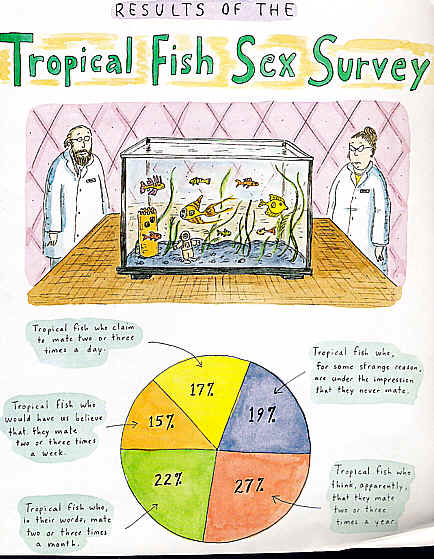
SHAMANARCHY
The first thing you have to do is accept that the collapse of the system is a positive thing. It's not a "depression" or a "recession" or all the horrible words They use because it's bad for Them. Unemployment going up? That's wonderful. That means a lot less people working at stupid, boring jobs producing crud we don't need, using up natural resources we don't have. Great!
When I became a hippie in the '60s, what that really involved was a decision to lower my consumption level by about 75 per cent. That's what the planet needs. it took a lot of courage, and I'm very proud I did that. I just wish the other 98 per cent of the people had done the same thing. They didn't and they're never gonna voluntarily give that stuff up. Now the planet's gonna force them to reduce their consumption level. It's gonna be a lot more chaotic, but it is happening.
The last thing we want now is breakdown of the social order, chaos, confusion, and civil war. We don't want that. Once you loosen things up, take away the controls -- that's the anarchy part -- then you have to have a metaphysical program of some kind for the thing to grow naturally into. That's the shamanarchy part.
-- Zen-Inspired Professional Pagan (Zippy) Fraser Clark
SILENCE
There is in the Eastern traditions the fiery practice of not knowing. This is not a prescription for feigning ignorance but for cultivating a sharp and attentive mind not given to easy answers. In the contemplative traditions, not having easy answers to everything that comes along is termed inner silence. In the beginning, then, our ability to respond creatively, whether at our desks, on the production floor, or on the yet-unwritten page, depends on our ability to live with the unexplored territory of silence.
-- David Whyte
Nothing deadens the soul more effectively than a dreary routine of thankless tasks. It may be necessary to break that routine quite violently to free the soul from the weight of petty cares. It may be necessary to disappear for a while, to go bush, in order to begin to reflect...There may be danger in taking time to be alone to reflect, and perhaps to grieve for times that can never return and, worse, bitterer, time that was wasted, but there is more danger in not taking it.
-- Germaine Greer
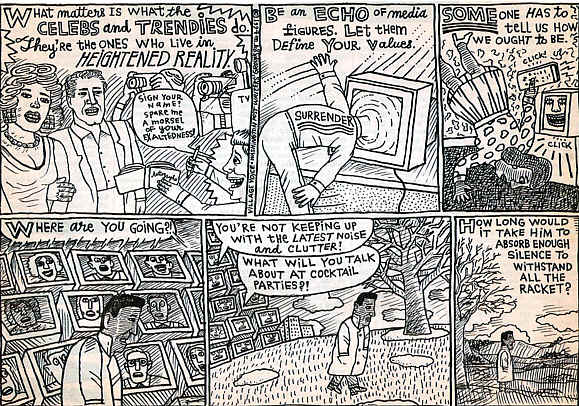
SPEED
Instant gratification just isn't fast enough.
-- Carrie Fisher
STAGNANCY AND SLIPPAGE
The human soul is not meant to be understood. Rather, take a more relaxed position and reflect on the way your life has taken shape. We all need to find a way to become individuals, by finding our own depths and even our own darkness, without cutting ourselves off from the maternal guidance within ourselves that keeps us in life and in community. We become persons through dangerous experiences of darkness; we can survive these difficult initiations. Any real initiation is always a movement from death to new life. Sometimes we may need to stop growing. We may need to backstep and regress. Growth, so often these days assumed automatically to be a goal in psychology and in life in general, can be a sentimental value that overlooks the necessity of such things as stagnancy and slippage. We are who we are as much because of our gaps and failures as of our strengths. Remember, soul appears most easily in those places where we feel most inferior.
-- Thomas Moore
TABOO
From The Culture of Desire, Frank Browning's precis of the philosophy of Georges Bataille:
"Only in the transgressive moment do we solitary humans relinquish the social identities that individuate us and distinguish us from the wild, polymorphous animal force of Eros that unifies all being.
"The bohemian response to civic taboo is to deny the rules of convention, to declare oneself free of taboo's boundaries. But Bataille goes further. To deny taboo, he would say -- to claim to have erased it from how we build our lives, choose our mates, seek sex -- is simply to live within a different safety zone of complacency. Only by acknowledging and searching out that framework of taboo, and then by entering into its violation, by feeling its fire, is there the possibility of shattering the self and gaining rebirth -- not some distant rebirth into an eventual eternity, but a continuous rebirth that comes of touching the eternal in the present."
TEARS
Tears! tears! tears!
In the night, in solitude, tears,
On the white shore dripping, dripping, suck'd in by the sand,
Tears, not a star shining, all dark and desolate,
Moist tears from the eyes of a muffled head;
O who is that ghost? that form in the dark, with tears?
What shapeless lump is that, bent, crouch'd there on the sand?
Streaming tears, sobbing tears, throes, choked with wild cries;
O storm, embodied, rising, careering with swift steps along
the beach!
O wild and dismal night storm, with wind -- O belching and
desperate!
O shade so sedate and decorous by day,
with calm countenance and regulated pace,
But away at night as you fly, none looking -- O then the
unloosen'd ocean,
Of tears! tears! tears!
-- Walt Whitman
TELLING YOUR STORY
First thing I learned by my own self, without anybody else telling me, my own first truth was this: fucking was the same way as with everything else -- what you thought you were doing was not what you were doing. What you thought you were doing was sucking and penetrating and kissing, holding, and ejaculating. What you were doing, though, was telling a story.
First off, thing is, you got to know you got a story. Then you got to have to tell it. Knowing how to tell your story good is important, but the secret to good fucking is how well you can listen. Fucking only gets good when the two stories start being the same story -- the human-being sex story -- when the two bodies stop being two bodies and start being the big excruciating, the one heart beating.
Most men, most sorry men, always tell the same old hard-dick ejaculation story, and always got to be the one who leans hard onto. Most women, sorry women, tell this story -- which really isn't a story: you talk, I'll listen, tell me when you're done. They always end up being the one who gets leaned hard on. Doesn't work that way when you're fucking. Good fucking is bartering, wrestling, swapping tales back and forth, and telling lies til you get to the truth.
-- Tom Spanbauer, The Man Who Fell in Love with the Moon
To be ourselves we must have ourselves -- possess, if need be repossess, our life-stories. We must "recollect" ourselves, recollect the inner drama, the narrative of ourselves. A man needs such a narrative, a continuous inner narrative, to maintain his identity, his self.
-- Oliver Sacks
THERAPY
Shallow therapeutic manipulations aimed at restoring normality or tuning a life according to standards reduces -- shrinks -- that profound mystery that is the very seed and heart of each individual to the pale dimensions of a social common denominator referred to as the adjusted personality. Care of the soul sees another reality altogether. It appreciates the mystery of human suffering and does not offer the illusion of a problem-free life. It sees every fall into ignorance and confusion as an opportunity to discover that the beast residing at the center of the labyrinth is also an angel...
The Greeks told the story of the minotaur, the bull-head flesh-eating man who lived in the center of the labyrinth. He was a threatening beast, and yet his name was Asterion -- Star. I often think of this paradox as I sit with someone with tears in her eyes, searching for some way to deal with a death, a divorce, or a depression. It is a beast, this thing that stirs in the core of her being, but it is also the star of her innermost nature. We have to care for this suffering with extreme reverence so that, in our fear and anger at the beast, we do not overlook the star.
-- Thomas Moore
THREESOME
"Charlotte and I have been together for a long, long time. We have adapted to each other's failings. Charlotte has affairs and as long as she pays attention to me, I tolerate it. I do that because I love her and want to be together with her. What is more important to me than the category or theoretical concept of the relationship is that I love Charlotte the woman."
"Triangles are a big mess," I said.
"No," she answered curtly, as though I was misinformed. "Everything can work, but all the responsibility is on the new lover. A romance is always more exciting than a marriage, and a new lover has moments of more power than the old one because you are not so familiar with their bag of tricks. Unfortunately Marianne did not have the grace to adapt to the limitations of her role. The best newcomer is one with a great deal of respect. They have to respect me and they have to be considerate of me. Then we can all be generous and each one satisfied on some level."
-- Sarah Schulman, After Delores
TO BE OR NOT TO BE
The soul favors the death experience to usher in change. Viewed this way, a suicide impulse is a transformation drive. It says: "Life as it presents itself must change."
-- James Hillman
*
"Live"
Well, death's been here
for a long time --
it has a hell of a lot
to do with hell
and suspicion of the eye
and the religious objects
and how I mourned them
when they were made obscene
by my dwarf-heart's doodle.
The chief ingredient is mutilation.
And mud, day after day,
mud like a ritual,
and the baby on the platter,
cooked but still human,
cooked also with little maggots,
sewn onto it maybe by somebody's mother,
the damn bitch!
Even so,
I kept right on going on,
a sort of human statement,
lugging myself as if
I were a sawed-off body
in the trunk, the streamer trunk.
This became a perjury of the soul.
It became an outright lie
and even though I dressed the body
it was still naked, still killed.
It was caught
in the first place at birth,
like a fish.
But I played it, dressed it up,
dressed it up like somebody's doll.
Is life something you play?
And all the time wanting to get rid of it?
And further, everyone yelling at you
to shut up. And no wonder!
People don't like to be told
that you're sick
and then be forced
to watch
you come
down with the hammer.
Today life opened inside me like an egg
and there inside
after considerable digging
I found the answer.
What a bargain!
There was the sun,
her yolk moving feverishly,
tumbling her prize --
and you realize that she does this daily!
I'd know she was a purifier
but I hadn't thought
she was solid,
hadn't known she was an answer.
God! It's a dream,
lovers sprouting in the yard
like celery stalks
and better,
a husband straight as a redwood
two daughters, two sea urchins,
picking roses off my hackles.
If I'm on fire they dance around it
and cook marshmallows.
And if I'm ice
they simply skate on me
in little ballet costumes.
Here,
all along,
thinking I was a killer,
anointing myself daily
with my little poisons.
But no.
I'm an empress.
I wear an apron.
My typewriter writes.
It didn't break the way it warned.
Even crazy, I'm as nice
as a chocolate bar.
even with the witches' gymnastics
they trust my incalculable city,
my corruptible bed.
O dearest three,
I make a soft reply.
The witch comes on
and you paint her pink.
I come with kisses in my hood
and the sun, the smart one,
rolling in my arms.
So I say Live
and turn my shadow three times round
to feed our puppies as they come,
the eight Dalmatians we didn't drown,
despite the warnings: The abort! The destroy!
Despite the pails of water that waited
to drown them, to pull them down like stones,
they came, each one headfirst,
blowing bubbles the color of cataract-blue
and fumbling for the tiny tits.
Just last week, eight Dalmatians,
3/4 of a lb., lined up like cord word
each
like a
birch tree.
I promise to love more if they come,
because in spite of cruelty
and the stuffed railroad cars for the ovens,
I am not what I expected. Not an Eichmann.
The poison just didn't take.
So I won't hang around in my hospital shift,
repeating The Black Mass and all of it.
I say Live, Live because of the sun,
the dream, the excitable gift.
-- Anne Sexton
UNCERTAINTY
The car is a private space that can go in any direction at any time. The motel room cinched that: anywhere you go, there will be a space for you -- a fact unique to contemporary life and alien to every previous society. But the fact that there's a room for you anywhere makes less substantial the place where you actually are. Thus you are a transient, without having chosen to be one. Human transience used to be defined almost solely by death. Now the fact of so much choice makes everyone a transient all the time -- and, for most of us now, makes any single choice almost unbearably tentative. Why be where you are, who you are, when you can just as easily be somewhere else, behaving differently?
This is a question that even most demographically "average" people ask often these days. how can it not make them more and more uncertain? So, to compensate, they're craving certainty in all the wrong places. In politics, which has always been uncertain. In metaphysics, which by its nature is uncertain. In love and sex, where certainty breeds boredom and diminishes lovers in each other's eyes. Many of these people blame the uncertain, tentative quality of their lives on "liberalism," "humanism," "relativism," "the sixties" -- when what is really going on is that they were once prisoners of time and space, and they will never be prisoners again, and they miss those prisons desperately.
How long will it take them to become accustomed to the new timeless, spaceless environment? This has become a crucial historical question. For until they acclimate themselves, they will continue to crave reactionary solutions that can only increase the chaos.
-- Michael Ventura
VULNERABILITY
The internal willingness to wrestle with our inner demons does not necessarily mean that anyone else...is brought into the drama. The real achievement is found when we acknowledge that these unresolved forces, our demons, affects our lives and those who work with us tremendously, simply because everything we do is determined by the fears and hopes we bring to a situation. Recognizing the presence of these forces in our own outlook, we can stop them from playing out unconsciously with our colleagues in the workplace. Nevertheless, a form of healing seems to take place when we find a truly sympathetic ear for our more difficult struggles. Just the opposite occurs when we confide in someone who is simply not interested or is secretly scared to death of what we have just revealed.
Goethe begins a famous German poem with the admonition "Tell a wise person or else keep silent." Our deeper struggles are in effect our greatest spiritual and creative assets and the doors to whatever creativity we might possess. It seems to be a learned wisdom to share them with others only when they have the possibility of meeting them with some maturity. We learn to remain attentive to the mood and outlook of the listener even before we begin to speak about the darker side of our existence.
Are they really listening? Do they really want to know? Is this frightening them? Will they think I am so weak that it will affect our work relationship for the worse? This last worry is usually connected to something in ourselves. Do we have
confidence in our struggles? Are they really our own, or are they another's struggle that we have simply borrowed in order to postpone a personal inner confrontation?
A mature individual should be able to handle any struggle we have confided in him. But many times the telling of such stories may overwhelm the listener. He may be paying close attention to our tale of woe, but cannot tell his own fears from the fears he is hearing from another's mouth. In a way, he is made uncomfortably aware of his own dark areas without having developed the skills to explore it himself. Our story, in effect, becomes a kind of persecution, as if the listeners are being pushed through a door they are not yet ready to enter. This feeling of persecution may lead to a kind of knee-jerk cutting comment or evasion on their part. Taking their comment as an attack rather than the desperate defense it is, we may feel devastated by their reaction. If we are paying enough attention at the beginning, we can stop our self-revelation before we scare them to death and elicit a fight-or-flight reaction. We could see this ability to really listen as a litmus test of those mythical creatures, the "empowered" and "unempowered" manager.
The empowered manager might be one who has some understanding of his or her own dark side and inner struggles. When she sees the possibilities for failure in those she manages,
she does not mistake them as her own. She can give them some room and understanding, she can allow others to experiment and sometimes fail. There are also those who cannot come to terms with the cyclical up-and-down nature of human experience; they have an irrational need to be eternally competent and expect others to be the same. A period of disclosure to such a person during a particularly difficult time can lead to the confessor being seen as thoroughly and eternally weak, an image that may be difficult to shake.
Finally, is it possible to keep on working while we grapple with the worry? There is something real about this question, beyond the puritanical finger-wagging of the work ethic. The answer is often yes. Work itself can continue to serve as a reference point, a grounding anchor point, outside of the necessarily chaotic reformation which is occurring in the psyche.
Psyche herself, personified in Greek myth as a quintessential representative of the awakening feminine, was set to work by Aphrodite in this fashion, counting and sorting seeds, this fine, detailed work serving as the greater metaphor of our lives, finding and recognizing what belongs together.
All in all, taking the above into account, we might wonder why we ever open our mouths at all! It may be in fact that there is no other listening ear in the workplace and the outer parts of the struggle are accomplished with family, friends, or the stranger who opens up a conversation on the flight to Cincinnati. In Europe there is a long tradition of telling, during long train journeys, one's whole life story to complete strangers. It allows the heart to ruminate on matters we are fearful of broaching in the company of those it may concern.
-- David Whyte
WE SUCK
Survey says:
97% of men questioned love to get their dicks sucked. Cocksucking improves job productivity, longevity of life, community stability, and creative resistance to homophobia and class war capitalism.
Another survey says:
The dude believes he seroconverted from oral sex, that is, this loving faggot got HIV from sucking dick. The survey indicates that there's one or more of these stories in every town. The death wish, the guilt, the slipping, the gambling, the misinformed, the resentment, the accident.
Survey says:
Denial is not an effective option. It's the lovers and the young ones getting HIV from sucking dick.
We say:
Give us a condom we can suck.
I want a new condom, sleeker than ever, with no foul rubber powder that ruins the taste. I want a cock worship enhancer, a barrier to bacteria, and an invitation to lick. The creation of this condom is of utmost international importance.
If we can put a man on the moon,
we can get a condom we can suck.
If we can train all the torturers in El Salvador,
we can train an entire nation of proud and safe cocksuckers.
If we can brainwash children into accepting violent and sexless marriage as a way of life, then we can teach an entire generation in the specific skills of aggressive self-defense and shameless sexual healing.
I need a condom I can suck!
You need a condom you can suck!
We need a condom we can suck!
I need a condom I can enjoy feeding you, every day, with a smile on my face, and a satisfied moan in the back of your throat.
Really I want a cure for HATE and a cure for AIDS and a cure for STUPIDITY.
All power to the fuck. Blessed be.
-- Keith Hennessy
X-RATED

YOUR JOB
"The Wild Geese"
You do not have to be good.
You do not have to walk on your knees
for a hundred miles through the desert, repenting.
You only have to let the soft animal of your body
love what it loves.
Tell me about despair, yours, and I will tell you mine.
Meanwhile the world goes on.
Meanwhile the sun and the clear pebbles of the rain
are moving across the landscapes,
over the prairies and the deep trees,
the mountains and the rivers.
Meanwhile the wild geese, high in the clean blue air,
are heading home again.
Whoever you are, no matter how lonely,
the world offers itself to your imagination,
calls to you like the wild geese, harsh and exciting --
over and over announcing your place
in the family of things.
-- Mary Oliver
ZEUS ENERGY
The step of the male bringing forth his own feminine consciousness is an important one -- and yet I have the sense there is something wrong. The male in the last 20 years has become more thoughtful, more gentle. But by this process, he has not become more free. He's a nice boy who pleases not only his mother but also the young woman he is living with.
What I'm proposing is that every modern male has, lying at the bottom of his psyche, a large, primitive man covered with hair down to his feet. Making contact with this wildman is the step the '70s male has not yet taken; this is the process that still hasn't taken place in contemporary culture.
The kind of energy I'm talking about is not the same as macho, brute strength, which mean already know enough about; it's forceful action undertaken, not without compassion, but with resolve.
The fault of the nuclear family isn't so much that it's crazy and full of double finds....The issue is that the son has a difficult time breaking away from the parents' field of energy, especially the mother's field, and our culture simply has made no provision for this.
Fathers no longer share their work with their sons. The strange thing about this is not only the physical separation, but also the fact that the father is not able to explain to the son what he's doing...in the world of offices, with the father only home in the evenings, and women's values so strong in the house, the father loses the son five minutes after birth. It's as if he had amnesia and can't remember who his children are. The father is remote: He's not in the house where we are, he's somewhere else. He might as well be in Australia.
If the son accepts his mother's view of his father, he will look at his own masculinity from a feminine point of view. But eventually the male must throw off this view and begin to discover for himself what the father is, what masculinity is....
The idea that male energy, when in authority, could be good has come to be considered impossible. Yet the Greeks understood and praised that energy. They called it Zeus energy, which encompasses intelligent, robust health, compassionate authority, diligent, physically healthy authority, good will, leadership. In sum, positive power accepted by the male in the service of the community. The Native Americans understood this too, that this power only becomes positive when it is exercised for the sake of the community, not for personal aggrandizement. All the great cultures have lived with images of this energy, except ours.
The male in touch with the wildman has true strength: He's able to shout and say what he wants in a way that the '60s and '70s male is not able to. The approach to his own feminine space that the '60s and '70s male has made is infinitely valuable, and not to be given up...The ability of a male to shout and be fierce is not the same as treating people like objects, demanding land or empire, expressing aggression -- the whole model of the '50s male. Getting in touch with the wildman means religious life for a man in the broadest sense of the phrase."
-- Robert Bly
1994 thanks to:
bob abramson * clint anderson * michael baker * scott baum * misha berson * aa bronson * collin brown * alan carrier * henry connell * bob cornfield * rob costin * jim curtan * michael dane * dennis d. * harry faddis * ferron * neal fox * mardi fritz * elinor fuchs * david gere * joseph aldo glussich * eve gordon * stan grof * david guy * anna halprin * steven hart * gay & kathryn hendricks * keith hennessy * randy higgins * james hillman * stephen holden * barbara huscher * kim irwin * lidell jackson * ryan kennedy * christine kondoleon * jack kornfield * david lida * chester mainard * mel mc kinney * michael meade * tim melester * charles michener * bruce mundt * jody oberfelder * ginette paris * john pasqualetti * andrew ramer * miguel rivera * doug sadownick * clive schneider-friedman * sarah schulman * matt silverstein * steve soba * malidoma some * sobonfu some * anna deveare smith * king thackston * mark thompson * max toledo * dirk velten * jonathan van meter * rosa von praunheim * john ward * tim whiteside * ross wetzsteon * winston wilde * joan witkowski * fred wittman * bill woodson
R.I.P.
emile ardolino * marc berman * walta borowski * mark carson * kurt cobain * william duff-griffin * david b. feinberg * terry helbing * derek jarman * harry kondoleon * andrew kopkind * bruce mailman * robert massa * michael mitchell * felix partz
* michael platt * john preson * marlon riggs * randy shilts *
danitra vance * ron vawter * jorge zontal

|