|
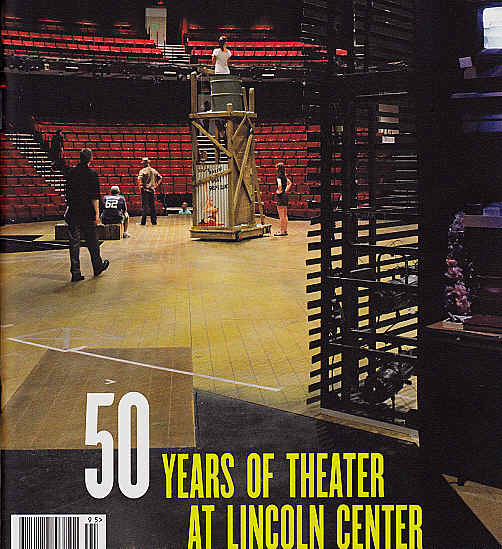
The history of a theater is usually told by the people who come in the front door, and it usually centers on the greatest hits, the star performances, and the artistic mission as defined by the founders and sustained by their successors. But actors have a different perspective on the life of a theater. They walk in a different door than the paying customers do, and just as the workers know things the bosses don't know, actors know things about the theater that audiences, critics, even the owners can't possibly know. They have their own personal history of the theater based on their interactions with the buildings, the staff, backstage, the audience, the rehearsal rooms, and the day-to-day run-of-the-show.
I spoke with thirteen prominent actors about their experiences
working at Lincoln Center Theater.
Most performers vividly remember their first time at Lincoln Center. “When I got the job to do
The Light in the Piazza, I’d already done five Broadway shows,” said Kelli O’Hara, who also starred as Nellie Forbush in
South Pacific. “But working at Lincoln Center was a huge deal for me. It is what I dreamed of as a singer, what I wanted my life to be. I’m from a little town in Oklahoma called Elk City. I didn’t come to New York even to visit until I was 21. The earliest memory I have of this city -- and it’s not that long ago -- was when I walked up the steps and stood in front of the fountain looking at the Met and the ballet and Avery Fisher.”
Billy Crudup had just graduated from New York University when he made his Lincoln Center debut in Tom Stoppard’s
Arcadia. “The first time you walk into the Vivian Beaumont, it’s a grand feeling,” he said. “When you come to work, you walk through the fountains and the opera and the symphony, and you feel like you’re at the cultural heart of New York. What better place to be as an up-and-coming creative artist!”
For Leleti Khumalo, who was 16 when she played the title role in Sarafina!, Lincoln Center was literally a foreign country. “We were supposed to be there for three weeks and go home to South Africa,” Khumalo said. “Then the show got extended, and they wanted to move it to Broadway. I didn’t know what Broadway was. I knew nothing about New York. I was just having fun!”
When Amy Irving was a teenager, Lincoln Center was literally home. Her father, Jules Irving, and his partner Herbert Blau, who founded the San Francisco Actors Workshop, were invited to take over the Lincoln Center Repertory Company in 1965. Since her mother, Priscilla Pointer, was a leading actress in the company, young Amy spent a lot of time backstage at Lincoln Center. “I’d watch the guillotine
scene at the end of Danton’s Death every night and memorized everybody’s part, whether it was James Earl Jones or Roscoe Lee Browne,” Irving recalled. “In their second production,
The Country Wife, I had a walk-on role. That was my professional stage debut. I was in a crowd scene in a booth. I sold a guinea pig to Stacy
Keach.”
For Julliard students like Patti LuPone, Lincoln Center was an extension of the campus, so near and yet so far. “I was in the first class of the drama division,” said LuPone. “We used to stare out of the windows of the Julliard School and gaze across the road to Lincoln Center.” Twenty years after graduation, LuPone made her debut at the Vivian Beaumont starring in Jerry Zaks’ 1987 revival of
Anything Goes. “I always thought it was the place where I belonged.”
Kevin Kline was a classmate of LuPone’s at Julliard. “Part of the training was seeing great classical plays at Lincoln Center,” he said. “I remember Blythe Danner as Viola in Ellis Rabb’s production of
Twelfth Night with Rene Aubornjois as Malvolio and Merchant of Venice with Rosemary Harris and Chris Walken.” Long before he played Falstaff in
Henry IV (2003) and the title role in Chekhov’s Ivanov (1997), Kline got his first job at Lincoln Center standing by for Raul Julia in Richard Foreman’s 1976 production of
The Threepenny Opera.
“When you’re an understudy, at least you’re onstage. The standby just sits around and waits,” said Kline. “Raul never missed a performance. When he left, Phil Bosco took over, and one day he came down with the flu. I got a call at 10 am on Sunday saying ‘You’re doing the matinee.’ That was my first time onstage at the Beaumont. It was terrifying because Macheath came out of the pit, walking in this stylized toe-heel animal-like prowl in slow motion, with his cane and derby hat. And as he walked upstage with his back to the audience, this huge wall of the proscenium started backing up from the sheer power of this prowling predator while Roy Brocksmith sang ‘Mack the Knife.’ It was a great entrance…except if you’re not sure if you’re going to faint or vomit or shit yourself. By the second act I started to have fun.”
Audra McDonald, another Julliard graduate, made a memorable first impression at Lincoln Center. “During my final callback for
Carousel, singing ‘When I Marry Mr. Snow’ on the stage of the Mitzi Newhouse Theater, I got so nervous because there was a possibility that I might actually get this that I just passed out,” she said. “For my first big audition for my first big role to basically end with me unconscious on the floor was kind of a good way to enter the building. When I came to, Mary Rodgers was saying, ‘Someone get her some orange juice!’”
“When you first go to work for Lincoln Center Theater, you walk through the door slightly intimidated,” said Cherry Jones, who won a Tony Award in 1995 for her performance in
The Heiress. “The reason the productions are so extraordinary is because Bernie Gersten and Andre Bishop almost literally cradle each artist in their arms. I’ll never forget the first reading of
The Heiress. There were a million people in the room, a large cast, the Goetz family members were there. I remember Andre coming in, all of us being nervous in his presence. He turned bright red and said, “I’m having a terrible hair day.” Of course we were all completely disarmed. Most actors in New York consider Lincoln Center Theater the pinnacle of pinnacles. You’re taken such good care of. They know what is required to produce good work.”
Sam Waterston first appeared at Lincoln Center in Hamlet in 1975, when the Vivian Beaumont was under the management of the New York Shakespeare Festival’s Joseph Papp and his associate producer Bernard Gersten. He has returned several times, most recently in 1993 for
Abe Lincoln in Illinois. “For me there was a continuity because of Bernie’s caring, attentive, careful oversight,” Waterston said. “He and Andre have a well-deserved reputation for being very hospitable and appreciative of actors. Always there, always interested, always involved, always watchful.”
Papp gave Meryl Streep, fresh out of Yale Drama School, her first professional job in New York in
Trelawney of the “Wells" alongside Mary Beth Hurt, John Lithgow, Jerry Dempsey, Mandy Patinkin, Sascha von Scherler, Michael Tucker, Aline McMahon and Walter Abel. “It was a wonderful cast in an adorable old play about a theatrical troupe at the turn of the (previous) century,” Streep said. “I learned how to be in a theatrical troupe from that play, how backstage was just as much fun as being on. John Lithgow, Mandy Patinkin, and I joined some of the others in forming a madrigal group. The stairwells and dressing rooms of the Beaumont have magical acoustics, and we made gorgeous sounds together every night. Scratch most actors and you'll find people that want to sing their little hearts out.”
The original conception of Lincoln Center included the vision of a resident acting company doing classic plays in repertory, under the direction of Robert Whitehead and Elia Kazan. Being part of an ongoing theatrical troupe performing old and new plays, comedies, tragedies and musicals in rotating repertory, is a dream that many actors cherish, as an alternative to the perpetual insecurity of competing for roles and repeatedly going back to square one that characterizes life in the commercial theater. But realizing that dream requires an often-elusive alliance of financial, artistic, and political resources. As illustrated by the history of American theater in general, and Lincoln Center Theater in particular, the company ideal can take many forms.
Among the actors hired to launch the Repertory Theater at Lincoln Center were Jason Robards Jr., Faye Dunaway, Salome Jens, and Hal Holbrook. Although he had already begun performing his now-famous
Mark Twain Tonight! Holbrook was thrilled to be asked to join the company, which began performing at a temporary theater in Washington Square while the Vivian Beaumont was still under construction. “The pressure of creating the great repertory company of the American theater was a heavy load,” Holbrook recalled. “But the second year, Bill Ball came in to direct
Tartuffe and brought with him all these terrific actors who were friendly and fun: Larry Gates, Sada Thompson, Michael O’Sullivan. I had three great roles that season. I took over the lead in
After the Fall from Jason Robards, I played the major in
Incident at Vichy and then I had this wonderful little five-minute routine in
Tartuffe. We had spirit, and the company started coming together. Then they axed us.”
After the second season, Whitehead and Kazan were replaced as artistic directors by Irving and Blau, who brought in their own ensemble of actors from San Francisco. It soon became clear to Holbrook that there was no place for him in the reconstituted company, and he left. “It’s a sad memory for me,” he admitted, “because it was something that I poured my heart and soul into. I wanted really bad to be a part of it and stay a part of it. And they wouldn’t let me.” In 1997, Holbrook returned to Lincoln Center Theater to appear with Kate Nelligan in Wendy Wasserstein’s
An American Daughter.
Philip Bosco was originally the only New York actor to join Irving and Blau’s new company in its first season. “It took me a while to get over the feeling of being an outsider,” he said. “But then I had seven very happy years doing four or five shows a season there.” For Bosco, as for many actors, financial stability ranked high among the advantages of belonging to a resident theater company. “I used to live on $10,000 a year, and that meant working constantly for $300 a week,” he said. “At Lincoln Center I was getting $500 a week. Then they upped it to $600 or $650, which to me was a fortune. So it was a boon for my family to have a regular salary.” In 1973 the Repertory Theater of Lincoln Center dissolved. Although the notion of an ongoing resident company has never returned to Lincoln Center, Bosco has done so many times, appearing in
Mrs. Warren’s Profession and The Threepenny Opera
during the Joseph Papp regime and in The Heiress and
Twelfth Night under Bishop and Gersten’s management.
The closest thing to rotating repertory that LCT has undertaken in recent years was
The Coast of Utopia, the trilogy of interlocking plays by Tom Stoppard that occupied the Vivian Beaumont for the entire 2006-2007 season. For Amy Irving, who appeared in two of the three plays, it was a return to her idyllic childhood. “I was so spoiled growing up in a repertory theater where the same actors were together doing show after show after show,” she said. “There was a real sense of family.
The Coast of Utopia was the closest thing to that I’ve experienced in the theater since then. It was a thrilling group of people to live with for a year.”
Of course, even individual productions develop their own sense of company cohesiveness. Playing the central role of long-distance swimmer Mabel Tidings Bigelow in Tina Howe’s
Pride’s Crossing (1997) was physically demanding for Cherry Jones. The character aged from 10 to 90 years old in the course of the play. The exhilarating reward for going the distance was the final scene, in which she dove from a platform into the arms of the supporting cast. She said, “There’s no greater way of ending a night of theater than being caught in the arms of your fellow actors and then being thrust heavenward.”
Sometimes adverse circumstances can generate unexpected bonds among the members of a company, as Stockard Channing discovered in 1990 with
Six Degrees of Separation. Blythe Danner had originally been cast in the leading role but bowed out during the early stages of rehearsal. “I was in San Diego at the Old Globe doing a Neil Simon play,
Jake’s Women,” recalled Channing, who made her LCT debut in
The House of Blue Leaves (1986) . “The marquee was up, the pictures had been taken, people had rented apartments, children enrolled in school. Suddenly it was announced that the show was closing out-of-town and not coming to New York. It was Easter weekend. I got a call from Bernie Gersten saying John Guare had written this play,
Six Degrees of Separation, the leading lady had decided she wasn’t going to do the play, they had a subscription situation… I said, ‘You don’t understand -- I feel like I never want to do a play again.’ I was in a quandary. Paul Benedict, an actor friend of mine, was staying in my apartment. He read the play and said, ‘It’s great. You should do it.’ I agreed to get on a plane and fly back and read the play with the company. There was this room full of actors staring at me. I felt like Wendy in
Peter Pan – ‘Come be our mother!’ They’d been rehearsing the one scene Ouisa Kittredge was not in. I sat down and read through it with everybody. There was this silence. I thought, ‘Oh, what the hell, it’s only going to be six weeks at the Mitzi.’ It turned out to be four years of my life.”
Musicals create unique opportunities for company solidarity to emerge. “The sitzprobe has always been my favorite day -- the first time they put the orchestra together with the cast,” said Kelli O’Hara. “For
South Pacific, I was excited and looking forward to it. But when Loretta Sayre, who plays Bloody Mary, got up in front of the orchestra, she started to bawl – like, audibly weep. She couldn’t go on. Ted [Sperling, the conductor] had to stop. She sat there for a minute to compose herself. It was silent for a while. Then she said, ‘I’ve never sung with an orchestra before.’ She’s 50, she’s Hawaiian, she did local shows and concerts with people coming through like Kenny Rogers. But she’s never worked anywhere else. You can get cynical -- too cool for school -- but when someone like that who’s so incredibly genuine and grateful gets to have this chance at that age in her life…that was a special moment.”
Audra McDonald has similarly cherished memories of the sitzprobe for Carousel. “They had the orchestra and the cast all set up in the lobby of the Beaumont during a late-winter snowstorm,” she said. “The sound was incredible. And we all sang and played Rodgers and Hammerstein facing the ceiling-high windows, looking out onto the Lincoln Center plaza and the gorgeous snow. That was 1994, and the moment is still completely burned in my brain.”
For some actors, discoveries made during rehearsals make unexpectedly long-lasting impressions. Hal Holbrook had an unforgettable experience working with Elia Kazan when he assumed the leading role in Arthur Miller’s
After the Fall. “I was going through a very bad time in my life,” he recalled. “My marriage was breaking up, and in some ways this role saved me from falling apart. I had two rehearsals with the cast before I took over. Kazan showed up for the last one. At the end of the second act, Quentin comes down these long stairs giving this enormous soliloquy, which I had interpreted as a realization of his guilt. I started the speech, and suddenly I got hit with this tremendous emotion. I started to cry but I kept stopping myself. I could hardly get through the speech. I didn’t intend to cry. I felt so ashamed. I just sat down at the end and stopped. There was a long silence. I felt like an idiot. Kazan walked down to the stage and sat down beside me on the steps and he said, ‘Why are you afraid to cry?’ I said, ‘Christ, I don’t know what happened. It’s ridiculous!’ He said, ‘It’s OK to cry.’ He put his hand on my knee and got up and left. To be given that encouragement by such a great director was a wonderful moment for me as an actor.” Moviegoers can attest that Holbrook has continued to make good use of that lesson, most recently in the performance that earned him his first Academy Award nomination, at age 83, in Sean Penn’s 2008 film
Into the Wild.
Meryl Streep’s second appearance at the Beaumont was in Andrei Serban's production of
The Cherry Orchard. “The glorious Irene Worth was Ranevskaya, the divine Raul Julia her nemesis, Mary Beth Hurt was the ingenue, and I was the maid,” Streep said. “They were all so wonderful and moving that I decided, just for laughs, to fall down at some point in every scene, either coming in or going out. I loved setting up an expectation, and the delicious drawing out of the moment when the inadvertent inevitably occurred. Yum. And hearing the laughs roll up from the back of the house like surround-sound: double yum. I found out that Bob DeNiro saw me in this perfectly shameless performance and recommended I play the modest Linda in
The Deer Hunter. That shows both the breadth of his imagination and his forgiveness.”
During the many months that actors spend together making a show, they intimately witness one another’s lives, both onstage and off: the joys and the sorrows, the terrors and the triumphs, the new loves and the painful losses. Sam Waterston’s strongest memory associated with
Abe Lincoln in Illinois is that both he and director Gerry Guttierez lost their mothers during the run of the show. “It was a gigantic event in both of our lives,” he said, “And it gave the play a lot of personal moments. Our feelings went into the play and made it richer.” Waterston also appreciated the compassionate concern of Lincoln Center Theater’s management. “My mother died just before the opening. Gerry and Andre and Bernie were unanimous in saying that we didn’t need to go on, and they were unanimous in helping me through it. When I went home, my father met me at the door. He said, ‘What are you doing here? Don’t you have a performance tonight?’ I said, ‘Yes.’ He said, ‘Hadn’t we better go?’ His attitude was that my mother never liked missing opening nights, and
even though she wouldn't be there, she would have wanted us to go.”
Kevin Kline experienced two similar moments during the run of Henry IV. “I remember Bernie coming to my dressing room an hour before curtain one night to say Gerry Gutierrez had died. I’d just talked to him a week before. Then I had to go on. And Michael Hayden’s sister was killed in a freak car accident the day of the first preview. He’d just heard that a couple of hours before the show. No understudy was ready so he went on. Only a few of us knew what had happened.” And although Kline wasn’t present, his wife’s sister was in the audience for
The Coast of Utopia the night Richard Easton collapsed onstage. “She said it was terrifying to watch,” said Kline. “Ethan Hawke or Martha Plimpton said, ‘Is there a doctor in the house?’ Ten guys came running. One had unbuckled his pants, and they slipped down as he was running down the aisle. One of the stagehands knew CPR and saved Richard’s life.”
A very different spirit prevailed when Patti LuPone got married on the stage of the Beaumont. “My husband proposed to me during the run of
Anything Goes,” she recollected. “One day I was in the stage manager’s office at intermission, and Matt said, ‘If you don’t set a date, we’re never going to get married.’ I said, ‘Okay, December 12.’ Then there was the question of where – Long Island where I grew up, New York where I’m performing, or Connecticut where we live? Bernie and his wife Cora [Cahan] came to me, and he said, ‘You have to get married on the stage of the Vivian Beaumont. Cora and I got married on the stage of the Anspacher Theater at the Public Theater and we’ve been together 30 years.’ We got married on our day off. I asked Bernie, ‘Who’s going to pay for the overtime?’ He said, ‘Lincoln Center will cover it.’”
Even mundane one-time events make lasting impressions on performers. “The Coast of Utopia
was a very large show with a lot of technical stuff going, like a musical,” said Amy Irving. “With that many people and that much stuff going on, you have to trust a lot of the people backstage to take care of you. In
Shipwreck, part two of the trilogy, I had a scene as Maria Ogarev that ended with my chaise longue dropping down in a little elevator offstage. One night I finish the scene and I’m laughing and smoking my cigarette. I’m supposed to sink down and exit, but nothing’s happening. I’m in the dark, I don’t know what to do. All of a sudden a stage manager comes and leads me off. I felt like Blanche DuBois being taken away at the end of
Streetcar. Turns out, the stage manager could see from the booth that my chaise was not aligned on the elevator floor, and if it had descended as usual I would have been tipped out. Luckily, I was saved.”
Patti LuPone had a memorable moment during Anything Goes. “At the end of the show, a net full of silk rose petals was released and the whole stage was showered with them,” she recalled. “One night I was beginning to do ‘Blow, Gabriel, Blow.’ I was wearing this diaphanous red gown Tony Walton designed. The top piece was two panels, held together from breast to breast by a string of four bugle beads. As I was singing, something caught my eye in the light, and I looked up. The audience followed my eyes to see what I was looking at. A single rose petal was wafting down from the ceiling and we followed it as it went right between my breasts. I had to turn my back and pull it out. It was a while before we had control of the audience again.”
Kevin Kline’s memories of playing the title role in Ivanov revolve around his acute sensitivity to audience responses. “I remember coming up against flu season,” he said. “Jayne Atkinson played my wife, who was tubercular. She said, ‘I can’t hear myself coughing above the coughing.’ I once sent out a bowl of cough drops to the audience. And I remember after the climactic moment when my wife comes in and sees me kissing Sasha -- Hope Davis – there was a very melodramatic light and sound cue, then Hope and I had to clear off stage left in the darkness. She said, ‘Did you hear what that man in the third row said? “That guy looks like Kevin Kline.”’ People just talk like they’re in front of a television screen! There was something in the program notes about the character of Ivanov being a narcissist. Right after I said some hateful, horrible line to my dying wife, there was a blackout, and the set slid slowly upstage. As I was going back into the recesses of darkness, I heard this woman in the front row say, ‘My God, he
is a narcissist.’”
Speaking of audiences, Stockard Channing said, “I love that when you’re in a show at Lincoln Center, you never know who’s going to be in the hallway afterwards. You’d open the door and there’d be Julie Andrews, Paul Newman, Robert Redford. People just march right down there.” For Leleti Khumalo as a teenager, it was a thrill to encounter Stevie Wonder and Eddie Murphy backstage. Amy Irving recalls going to the opening night of
Camino Real and meeting Tennessee Williams. “I was too young to have a real conversation with him,” Irving said. “But I was the boss’s daughter, and I got to hang out backstage with everybody.”
Curtain calls are always gratifying to performers. But after marathons of The Coast of
Utopia, when all three parts of the trilogy were performed in a single day, an extraordinary ovation greeted the cast. “The back-and-forth energy was unbelievable,” said Irving. “It felt like we’d been at a rock concert.” The marathons were unusual for Irving and Billy Crudup, because they were not in the third play. “When I died in the second play,” said Crudup, “I’d go home and have a nap, put my son to sleep, and then go back for the curtain call. It’s a very perverse feeling. I used to tell people, ‘I have to run uptown for a minute to get people to clap for me. I’ll be right back.’”
For Audra McDonald, the final curtain call for the 1999 production of Michael John LaChiusa’s
Marie Christine remains one of the high points of her association with Lincoln Center. “Even though
Marie Christine wasn’t the commercial or critical success we wanted it to be, I remember as I was bowing at the end of that last performance, I was so emotional and so proud of the work we had done,” she said. “And I was grateful that there was a place like Lincoln Center Theater that would allow ambitious new works like that to be done, give them a home, let them run their course, and support them.”
Lincoln Center Theater Review, August 2009
A longer version of excerpts from these interviews ("the
DVD extras") is available here.
|